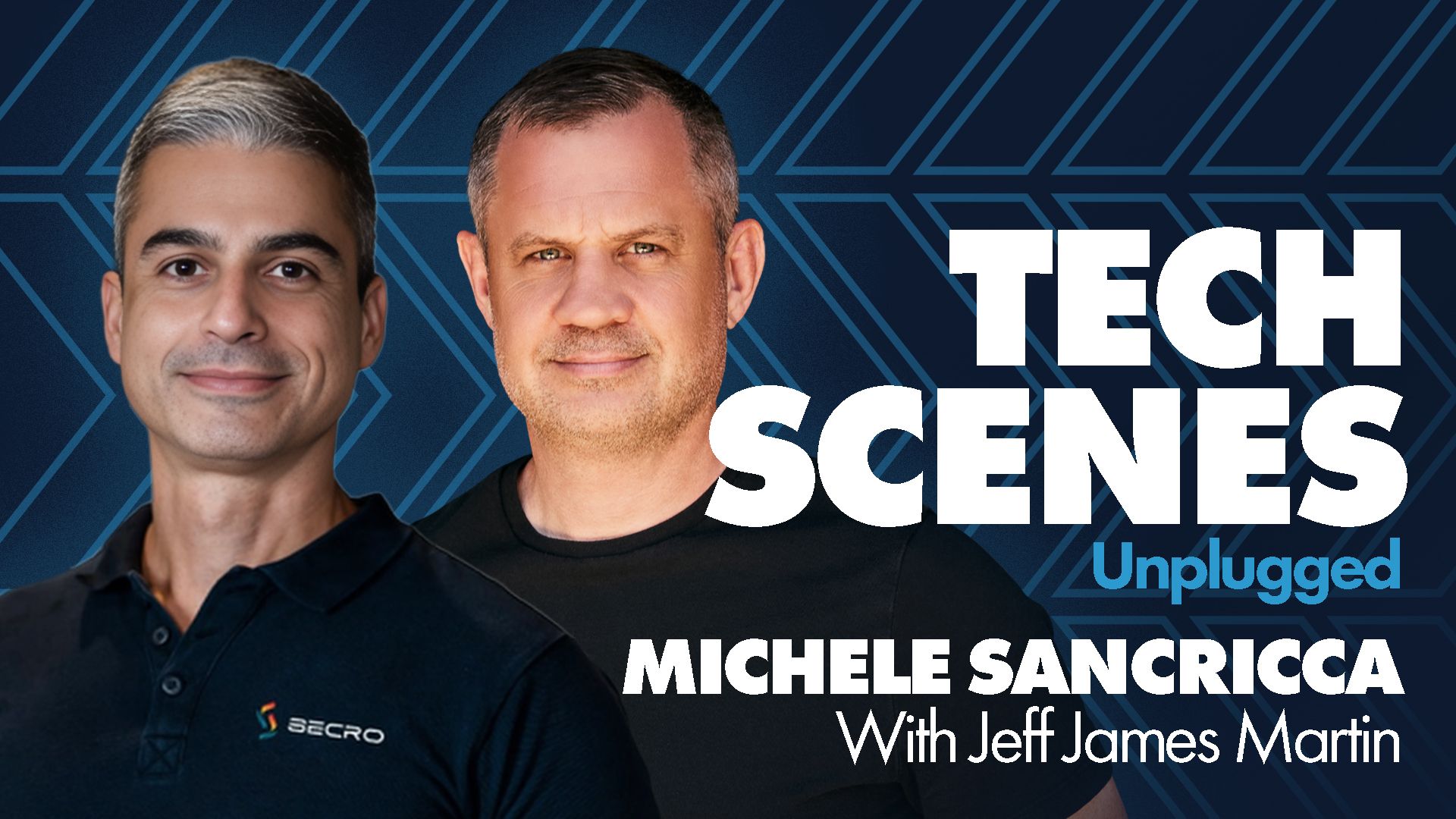
Tech Scenes Unplugged with Michele Sancricca CEO and founder of Secro
Tech Scenes Unplugged with Michele Sancricca, CEO and Founder of Secro
Why Trust, Speed, and Decision-Making Matter in a $30 Trillion Industry
In this episode of Tech Scenes Unplugged, Collective Genius Founder Jeff Martin sits down with Michele Sancricca, CEO and Founder of Secro, to explore one of the world's largest yet least digitized industries: global trade.
From combating piracy in the Italian Navy to leading digital transformation initiatives at major shipping organizations and Amazon, Michele has spent his career solving complex operational problems across global systems.
Today, through Secro, he is helping modernize international trade by bringing security, trust, automation, and digital workflows to an industry that still relies heavily on paper documents, manual processes, and fragmented communication.
The conversation explores leadership, scaling teams, organizational systems, founder growth, decision-making, AI, customer feedback loops, and why trust remains one of the most valuable assets in business.
Watch and Listen
Watch the Full Episode on YouTube
Listen on Spotify
https://open.spotify.com/episode/4zzlM6GscjLwFcs7mtVgjg?si=zW1S31veR2CWUZrEvgXRGA
Meet Secro
Secro is a workflow automation and security platform designed for global trade.
The company helps banks, insurance providers, logistics companies, and commodity traders digitize some of the most critical and complex documentation workflows in international commerce.
Many people assume global trade has already been digitized.
The reality is quite different.
According to Michele, many critical trade processes still depend on:
-
Paper documentation
-
Email-based workflows
-
Excel spreadsheets
-
Manual approvals
-
Fragmented systems
This creates inefficiencies, delays, security risks, fraud exposure, and operational complexity.
Secro's mission is to create a trusted digital infrastructure that reduces transaction risk while improving transparency and efficiency across global trade ecosystems.
Fighting Modern-Day Pirates
One of the most fascinating parts of Michele's story is his background in the Italian Navy.
During his military career, he participated in anti-piracy operations and helped protect commercial shipping routes.
Today, he jokes that he is still fighting pirates.
The difference is that modern pirates often operate through fraud, cybercrime, document manipulation, and financial deception rather than armed attacks at sea.
This perspective gives Michele a unique understanding of trust, security, and risk management.
The challenges may look different today, but the underlying problem remains the same:
How do you protect valuable assets moving through complex global systems?
Why Trust Is the Foundation of Global Trade
One of the strongest themes throughout the conversation is trust.
International trade depends on trust between multiple parties:
-
Buyers
-
Sellers
-
Banks
-
Insurance providers
-
Logistics companies
-
Freight operators
-
Regulators
When information is inaccurate, delayed, duplicated, or manipulated, risk increases dramatically.
Fraud becomes easier.
Insurance becomes more expensive.
Transactions become slower.
Relationships deteriorate.
Secro's approach focuses on strengthening the chain of trust through secure digital workflows and verified documentation.
The Hidden Cost of Paper-Based Systems
Many business leaders assume paper processes are simply inefficient.
The reality is much more significant.
Paper-based systems create:
-
Operational delays
-
Duplicate work
-
Compliance challenges
-
Security vulnerabilities
-
Increased fraud exposure
-
Limited visibility
In industries moving billions and trillions of dollars in transactions, even small inefficiencies become massive economic costs.
Digitization is not simply about convenience.
It becomes a strategic advantage.
What Michele Learned from Amazon
After his military career and work in global shipping, Michele joined Amazon and later AWS.
There he gained firsthand experience building systems at massive scale.
One of the key lessons he shares is the importance of documentation.
Amazon's culture emphasizes writing.
Ideas are documented.
Strategies are documented.
Product launches are documented.
Decision-making becomes clearer when thinking is written down.
This lesson continues to influence how Michele builds Secro today.
Why Writing Creates Alignment
One of the most practical discussions in the episode centers around documentation.
Many organizations talk about vision.
Few write it clearly.
Fewer revisit it consistently.
Michele explains how some of the early strategic documents created years ago at Secro continue to guide decisions today.
Writing creates clarity.
Clarity creates alignment.
Alignment creates execution.
For growth-stage companies, documenting vision, priorities, assumptions, and decisions often becomes a critical scaling mechanism.
The Founder Evolution Challenge
As companies grow, founders face a difficult transition.
In the beginning, founders are involved in everything.
Every customer conversation.
Every product decision.
Every hiring discussion.
Every operational challenge.
At a certain point, that model breaks.
The company becomes too large to fit inside one person's head.
Michele describes this realization as a defining moment in leadership development.
The founder can no longer be the system.
The organization needs systems.
It needs leaders.
It needs delegation.
It needs trust.
This transition is one of the hardest challenges growth-stage founders face.
Why Feedback Loops Matter
One of Michele's strongest beliefs is the importance of maintaining short feedback loops.
Markets change rapidly.
Customers change rapidly.
Technology changes rapidly.
AI is accelerating this even further.
The companies that learn fastest gain an advantage.
The companies that wait too long to adapt often struggle.
Michele emphasizes that startups can no longer rely on quarterly feedback cycles.
In many cases, learning needs to happen weekly or even daily.
The speed of learning increasingly determines the speed of growth.
The Challenge of Scaling Teams
Secro operates across multiple countries and time zones.
This creates unique leadership challenges.
As organizations grow internationally, alignment becomes more difficult.
Communication becomes more complex.
Decision-making becomes more distributed.
Michele explains that success requires building local ownership while maintaining global alignment.
The goal is not central control.
The goal is distributed accountability connected by a shared vision.
Why Diversity Strengthens Teams
One of the most insightful sections of the conversation focuses on diversity.
Secro's team includes people from numerous countries and backgrounds.
Different cultures bring different perspectives.
Different experiences create different solutions.
Different viewpoints challenge assumptions.
Michele believes this diversity strengthens decision-making and helps organizations solve more complex problems.
Innovation often emerges from the collision of different perspectives.
Leadership Means Letting Go
Several times during the conversation Michele returns to a lesson learned both in the military and as a founder:
Leaders eventually have to let go.
Micromanagement may work in the beginning.
It does not scale.
At some point leaders must trust their teams.
They must empower others to make decisions.
They must create clarity and accountability without controlling every outcome.
This transition is uncomfortable.
But it is necessary for growth.
Why AI Changes the Speed of Business
The discussion also explores AI's impact on startups.
Michele believes AI is dramatically compressing timelines.
Features can be built faster.
Competitors can emerge faster.
Markets can shift faster.
As a result, founders must become more responsive.
Decision-making speed becomes increasingly important.
Learning speed becomes increasingly important.
Execution speed becomes increasingly important.
The organizations that adapt fastest often gain disproportionate advantages.
Innovation in Conservative Industries
One of the most interesting strategic discussions involves building innovative products in highly regulated industries.
Many founders pursue markets with rapid adoption.
Michele intentionally chose a different path.
Global trade is conservative.
Banks are conservative.
Insurance providers are conservative.
Adoption cycles are slower.
But successful companies become deeply embedded once trust is established.
This creates durable competitive advantages.
In Michele's view, building in difficult industries often creates stronger long-term businesses.
Key Quotes from the Episode
"The company becomes bigger than your brain."
"The key to startup success is the feedback loop."
"You need to learn how to let go."
"Planning is essential."
"Write it down."
"Trust is everything in global trade."
"The founder cannot remain the system forever."
"Speed of learning determines speed of growth."
Key Takeaways
-
Trust remains one of the most important assets in business.
-
Digitization creates strategic advantages beyond efficiency.
-
Founders must evolve as organizations grow.
-
Feedback loops are critical for decision-making.
-
Documentation creates organizational alignment.
-
Diverse teams often make better decisions.
-
AI is accelerating the pace of competition.
-
Leadership requires learning when to let go.
-
Conservative industries can create powerful opportunities.
-
Strong systems enable sustainable growth.
Frequently Asked Questions
What is Secro?
Secro is a workflow automation and security platform focused on digitizing complex trade and financial documentation workflows.
What problem does Secro solve?
The company helps reduce fraud, improve trust, increase efficiency, and digitize paper-heavy workflows across global trade ecosystems.
Why is trust so important in global trade?
International transactions involve multiple parties, jurisdictions, financial institutions, and documentation requirements. Trust reduces risk and improves efficiency.
Why do founders struggle to scale?
As organizations grow, founders must transition from doing everything themselves to empowering leaders and building scalable systems.
Why are feedback loops important?
Short feedback loops help companies learn faster, adapt faster, and make better decisions.
How is AI changing business?
AI is increasing the speed of product development, competition, learning, and execution across nearly every industry.
Why is documentation important?
Documentation improves clarity, alignment, accountability, and organizational memory.
Related Insights
What Is Organizational Execution?
What Is Organizational Intelligence?
What Is a Business Operating System?
About the author
Jeff James MartinCEO and Founder, Collective Genius
Jeff James Martin is the Founder and CEO of Collective Genius, creator of Peak OS, and author of Peak Teams. He works with growth and mission-critical organizations to improve alignment, accountability, execution, and team performance. Over the past two decades, Jeff has helped hundreds of founders, executives, and leadership teams build stronger operating rhythms and scale through increasing complexity. He is also the host of Tech Scenes, where he interviews founders, investors, and operators on leadership, innovation, and organizational performance.
About Peak OS
Peak OS is the operating system for organizational execution. Designed for growth-stage and mission-critical organizations, Peak OS helps leadership teams align priorities, establish operating rhythm, improve accountability, and maintain visibility as organizational complexity increases. By creating a consistent framework for communication, planning, and execution, Peak OS helps teams reduce execution drift and turn strategy into measurable outcomes. Learn more: Collective Genius
About Collective Genius
Collective Genius helps founders, executive teams, and growing organizations improve organizational execution through leadership coaching, operating systems, strategic facilitation, and Team-of-Teams alignment. Our work focuses on helping organizations scale without losing clarity, accountability, communication, or momentum. Learn more: Collective Genius
About Peak Teams
Peak Teams: Mastering the Habits of Unstoppable Venture-Backed Companies explores the leadership habits, operating rhythms, accountability systems, and execution principles used by high-performing organizations. The book provides practical frameworks for leaders seeking to build aligned teams and execute consistently as complexity grows. Learn more: Peak Teams book
Learn More
Explore additional insights on organizational execution, operating rhythm, leadership, team alignment, business operating systems, artificial intelligence, and the future of work through the Collective Genius Insights platform. Visit: Collective Genius Insights
Music by Andrew Applepie - https://soundcloud.com/andrewapplepie
