
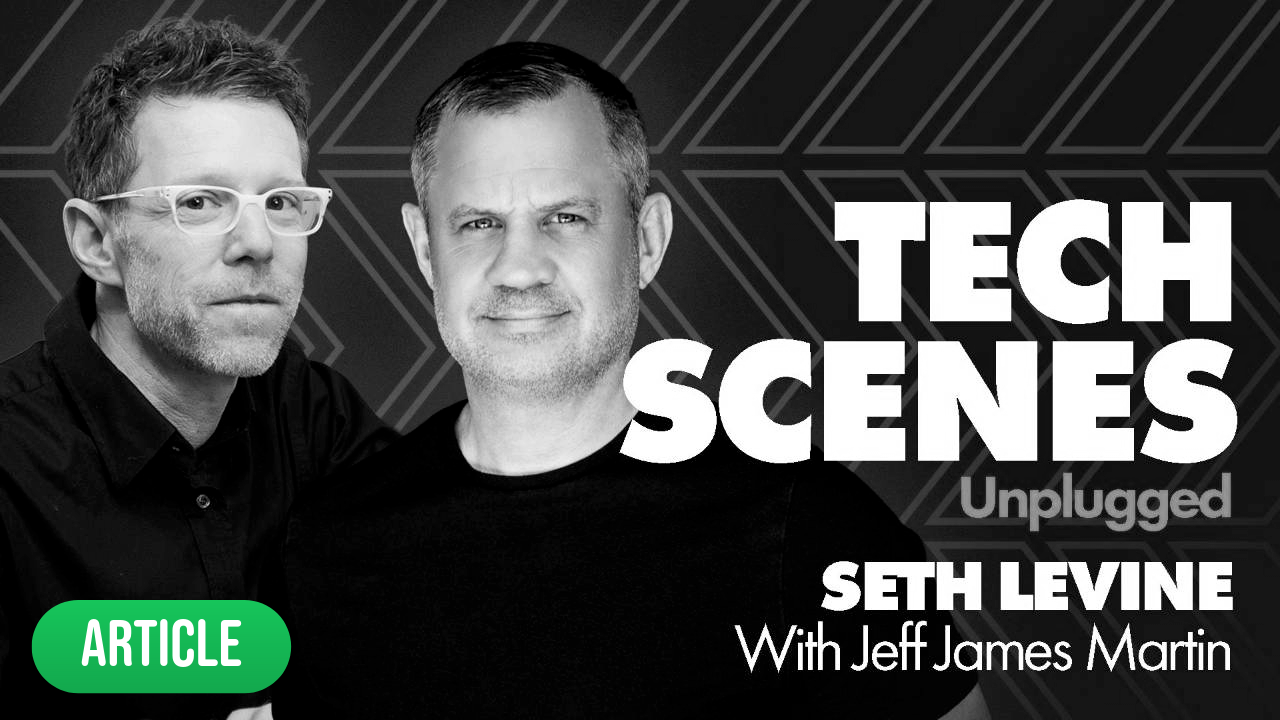
Why Great Organizations Create More Owners, Not Just More Employees
Most conversations about capitalism focus on money.
The more important conversation may be about ownership.
That was one of the strongest themes that emerged during a recent Tech Scenes conversation with Seth Levine, Managing Director at Foundry, entrepreneur, investor, and co-author of Capital Evolution.
You can watch the full Tech Scenes episode here:
-
https://www.collective-genius.com/blog/tech-scenes-with-seth-levine-co-author-of-capital-evolution
-
YouTube: https://youtu.be/u1W309DriVM
-
Spotify: https://open.spotify.com/episode/5hWYraNmkxnECvHvqzxAGa?si=QyFMTmxRROyqM3z_QLvGqw
The conversation began around the future of capitalism, employee ownership, and Seth's new book Capital Evolution.
But underneath those topics was a deeper organizational question:
How do organizations create alignment, ownership, and long-term success as they grow?
The Middle Class Challenge Is Really an Ownership Challenge
One of the central ideas Seth explores in Capital Evolution is the belief that economic systems work best when more people participate in ownership.
For decades, many workers participated in company success primarily through wages.
Today, an increasing percentage of value creation flows to shareholders rather than employees.
Seth argues that one path forward is creating more owners.
Not necessarily by reducing capitalism.
But by expanding participation within it.
This is one reason employee ownership models, equity participation, and ESOP structures have gained increasing attention.
Ownership changes behavior.
When people feel connected to outcomes, they often become more invested in:
-
execution
-
collaboration
-
accountability
-
innovation
-
long-term success
The strongest organizations often create environments where employees think like owners rather than simply workers.
Alignment Is Easier When People Feel Ownership
One of the most interesting moments in the conversation was the discussion around employee ownership and organizational culture.
Many high-growth organizations naturally create stronger alignment because employees participate directly in the upside through equity.
The same dynamic often appears in employee-owned companies.
People begin viewing success differently.
Instead of asking:
"What does the company owe me?"
Teams increasingly ask:
"How do we create success together?"
That subtle shift can have enormous implications for:
-
collaboration
-
decision-making
-
accountability
-
team cohesion
-
organizational trust
As organizations scale, these behaviors become increasingly important.
Complexity cannot be managed through rules alone.
It requires commitment.
Ownership often strengthens that commitment.
Why Dynamic Capitalism Requires Organizational Learning
A major concept introduced by Seth is what he calls dynamic capitalism.
Rather than viewing capitalism as a fixed system, dynamic capitalism recognizes the need for continuous adaptation.
The same principle applies to organizations.
High-performing organizations rarely succeed because they have perfect plans.
They succeed because they learn quickly.
The companies that scale best typically build systems that help teams:
-
gather feedback
-
learn from mistakes
-
improve execution
-
adapt to changing conditions
-
maintain alignment
Organizational learning is increasingly becoming a competitive advantage.
In rapidly changing environments, learning speed often matters more than planning accuracy.
Why Great Leaders Stay Close to Reality
One of Seth's strongest recommendations for CEOs was remarkably simple:
Spend more time outside the executive suite.
As organizations grow, leaders often become increasingly removed from:
-
customers
-
frontline employees
-
operational challenges
-
day-to-day realities
This distance creates risk.
Important information becomes filtered.
Problems become harder to see.
Decision quality declines.
The best leaders actively create systems that keep them connected to reality.
They spend time:
-
talking with employees
-
listening to customers
-
observing operations
-
gathering direct feedback
Leadership visibility often becomes more important as organizations scale.
Not less.
Why Time Is a Form of Capital
One of the most powerful parts of the conversation centered around capital efficiency.
Seth described time as a scarce resource similar to financial capital.
Organizations have limited:
-
capital
-
energy
-
attention
-
time
Every decision represents an investment.
The challenge for leaders is deciding where those resources should be allocated.
This applies equally to:
-
startups
-
growth companies
-
mature organizations
-
nonprofits
-
mission-critical teams
The best leaders understand that organizational focus is ultimately an allocation problem.
What receives attention grows.
What does not receive attention often stalls.
Why Great Teams Pause to Accelerate
One of the strongest themes throughout the conversation was the value of recurring strategic pauses.
Seth described how Foundry built a disciplined cadence of quarterly offsites, leadership discussions, and coaching sessions.
Those pauses were not distractions from execution.
They were essential to execution.
Many leaders resist slowing down because they feel too busy.
Yet the opposite is often true.
Organizations become less efficient when they never stop to evaluate:
-
priorities
-
alignment
-
communication
-
strategy
-
execution
Without reflection, teams often drift.
Without alignment, effort becomes fragmented.
Without operating rhythm, complexity accumulates.
The most successful teams frequently step away from day-to-day activity in order to improve long-term performance.
AI, Productivity, and the Future of Work
The conversation also explored AI and its potential impact on employment.
Seth described himself as a techno-optimist.
While acknowledging the uncertainty surrounding AI, he emphasized an important point:
Throughout history, major technological shifts have created new opportunities even as they disrupted existing work.
From agriculture to manufacturing to the internet, economic transformation has repeatedly reshaped labor markets.
AI may prove no different.
The challenge for leaders is not simply reacting to change.
It is creating organizations capable of adapting to change.
The organizations that learn fastest will likely have the greatest advantage.
Why Organizational Alignment Becomes More Valuable as Complexity Grows
As organizations grow, communication becomes harder.
Decision-making becomes slower.
Priorities become less obvious.
Complexity increases.
This is why alignment becomes increasingly valuable over time.
The organizations that scale effectively often create systems that help teams maintain:
-
visibility
-
accountability
-
ownership
-
learning
-
coordinated execution
Those capabilities become strategic advantages.
Not because they eliminate complexity.
But because they help organizations navigate it.
Frequently Asked Questions
What is dynamic capitalism?
Dynamic capitalism is Seth Levine's concept that capitalism should continue evolving to create broader prosperity, stronger ownership participation, and more sustainable long-term economic outcomes.
Why does employee ownership matter?
Employee ownership can increase engagement, accountability, collaboration, and alignment by helping employees participate directly in organizational success.
Why should leaders stay connected to frontline teams?
Direct exposure to customers, employees, and operations helps leaders make better decisions and maintain awareness of emerging challenges.
Why are offsites important?
Offsites provide teams with dedicated time to evaluate strategy, improve alignment, strengthen relationships, and clarify priorities.
What is operating rhythm?
Operating rhythm is the recurring cadence organizations use to maintain alignment, communication, accountability, and coordinated execution.
How will AI impact work?
While the long-term effects remain uncertain, AI is likely to reshape how work is performed while also creating new opportunities, roles, and business models.
Related Concepts
-
Dynamic Capitalism
-
Employee Ownership
-
Organizational Learning
-
Leadership Alignment
-
Operating Rhythm
-
Capital Efficiency
-
Strategic Planning
-
Founder Evolution
-
Team Coordination
-
Organizational Execution
Key Takeaways for Leaders
As organizations grow, complexity increases faster than most leaders expect.
The strongest lesson from this conversation is that sustainable growth requires more than capital.
It requires ownership.
Leaders should focus on:
-
creating recurring operating rhythm
-
increasing organizational visibility
-
strengthening employee ownership
-
accelerating organizational learning
-
improving leadership alignment
-
maintaining focus as complexity grows
The organizations that scale most effectively are rarely the organizations with the most activity.
They are the organizations capable of maintaining alignment, ownership, and learning as complexity increases.
Frequently Asked Questions
What is employee ownership?
Employee ownership is a business structure that allows employees to participate in the value they help create. This can include stock options, equity grants, profit-sharing programs, ESOPs (Employee Stock Ownership Plans), or other ownership mechanisms.
Why does ownership matter in organizations?
Ownership often changes behavior. When people feel connected to organizational outcomes, they tend to become more invested in collaboration, accountability, innovation, and long-term success.
What is an employee-owned company?
An employee-owned company is an organization where employees hold a meaningful ownership stake in the business. Ownership structures can range from partial participation to majority employee ownership through an ESOP or similar model.
How does ownership impact company culture?
Ownership can strengthen trust, engagement, accountability, and alignment. Employees who think like owners often make decisions with a longer-term perspective and a greater focus on organizational success.
What is dynamic capitalism?
Dynamic capitalism is a concept explored by Seth Levine in Capital Evolution. It suggests that capitalism should continue evolving to create broader opportunities for ownership, participation, and long-term prosperity.
Why do growth organizations need alignment?
As organizations scale, communication becomes more complex and priorities become harder to coordinate. Alignment helps teams stay focused on shared goals while maintaining accountability and execution.
What role does leadership play in creating ownership?
Leaders create ownership by building trust, sharing information, aligning incentives, providing autonomy, and helping employees understand how their work contributes to organizational success.
How can organizations encourage an ownership mindset?
Organizations can encourage ownership by creating transparency, clarifying goals, increasing accountability, involving employees in decision-making, recognizing contributions, and providing opportunities to participate in long-term value creation.
Why is organizational learning important?
Organizations that learn quickly often adapt more effectively to changing markets, customer needs, and competitive pressures. Learning helps teams continuously improve execution and decision-making.
How does ownership connect to organizational execution?
When employees feel ownership, they are often more engaged in solving problems, supporting teammates, improving processes, and contributing to organizational goals. This can strengthen execution across the organization.
Related Insights from Tech Scenes
The themes discussed with Seth Levine connect directly to several broader conversations around leadership, organizational execution, AI, and scaling organizations:
-
Why Growth Companies Need Faster Organizational Learning Loops
https://www.collective-genius.com/blog/why-growth-companies-need-faster-organizational-learning-loops -
Why Founders Struggle to Become CEOs
https://www.collective-genius.com/blog/why-founders-struggle-to-become-ceos -
Why Growth Companies Need Operating Systems That Reduce Founder Isolation
https://www.collective-genius.com/blog/why-growth-companies-need-operating-systems-that-reduce-founder-isolation -
Why Organizational Systems Matter More as Companies Scale
https://www.collective-genius.com/blog/why-organizational-systems-matter-more-as-companies-scale -
Why AI Makes Organizational Alignment More Important, Not Less
https://www.collective-genius.com/blog/why-ai-makes-organizational-alignment-more-important-not-less
Together, these articles explore a common theme:
Organizations scale best when they combine ownership, alignment, learning, and execution into a repeatable operating rhythm.
Related Resources
Peak Teams – Mastering the Habits of Unstoppable Venture-Backed Companies
https://www.amazon.com/Peak-Teams-Mastering-Unstoppable-Venture-Backed/dp/1962341143
Peak Teams explores many of the organizational execution concepts discussed throughout this article, including:
-
operating rhythm
-
leadership coordination
-
organizational synchronization
-
measurable alignment
-
team execution
-
scaling complexity
The book provides practical frameworks for helping organizations stay aligned and execute effectively as complexity increases.
Collective Genius
https://www.collective-genius.com/
Collective Genius helps growth and mission-critical organizations strengthen:
-
organizational execution
-
leadership alignment
-
operating cadence
-
execution visibility
-
team coordination
-
scaling systems
The organization works with leadership teams to improve alignment, focus, accountability, and execution as companies grow.
Peak OS Software
https://www.collective-genius.com/peak-os-software
Peak OS is an organizational execution platform designed to help teams create:
-
measurable alignment
-
recurring operating rhythm
-
execution visibility
-
OKR management
-
team synchronization
-
leadership coordination
Peak OS combines software, methodology, and operational frameworks to help organizations maintain signal as complexity grows.
Additional Tech Scenes Conversations
https://www.collective-genius.com/blog
Tech Scenes explores how founders, CEOs, investors, operators, and technology leaders think about:
-
leadership
-
organizational design
-
AI transformation
-
operating systems
-
execution strategy
-
scaling organizations
Additional episodes and operational insights can be found throughout the Tech Scenes library.
