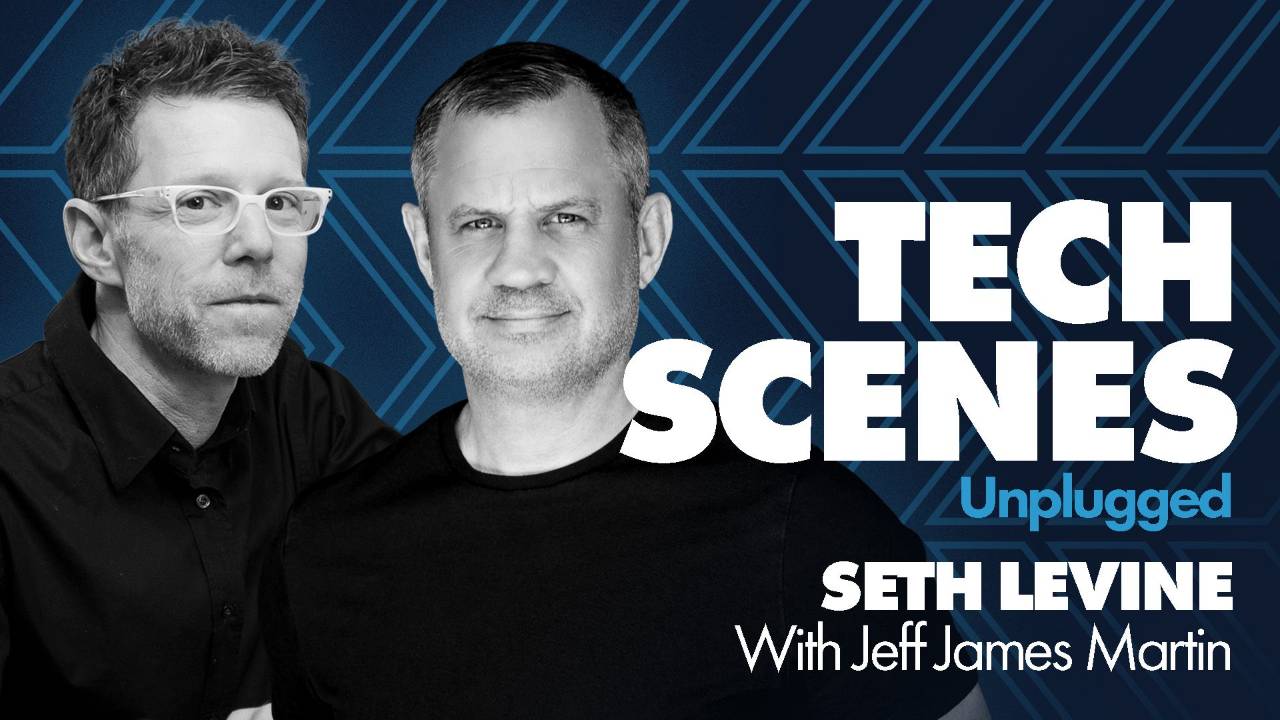
Tech Scenes with Seth Levine Co-Author of Capital Evolution
Tech Scenes with Seth Levine, Co-Author of Capital Evolution
Rethinking Capitalism, Ownership, and Opportunity
In this episode of Tech Scenes, Collective Genius Founder Jeff Martin sits down with Seth Levine, Managing Director and Co-Founder of Foundry, and co-author of Capital Evolution, to explore one of the most important questions facing business leaders today:
What should capitalism look like in the future?
As artificial intelligence reshapes industries, entrepreneurship continues to evolve, and trust in institutions declines, leaders are increasingly questioning whether traditional models of capitalism still serve employees, communities, founders, investors, and society as a whole.
Throughout the conversation, Seth shares insights from years of investing in startups, building Foundry, researching the future of capitalism, and writing Capital Evolution. The discussion spans entrepreneurship, employee ownership, venture capital, AI, leadership, organizational alignment, and the role businesses can play in creating opportunity.
More than anything, this episode is about understanding how organizations can create prosperity while remaining human-centered.
Watch and Listen
Watch the Full Episode on YouTube
Listen on Spotify
https://open.spotify.com/episode/5hWYraNmkxnECvHvqzxAGa
Why Seth Wrote Capital Evolution
The inspiration behind Capital Evolution came from a growing observation.
Many people no longer believe the current economic system is working.
Younger generations increasingly question capitalism itself. Economic mobility has declined. Wealth concentration has increased. Trust in institutions has eroded. Political polarization has intensified.
Rather than defending the status quo or advocating for entirely new systems, Seth wanted to explore a more productive question:
How should capitalism evolve?
Together with co-author Elizabeth MacBride, Seth interviewed CEOs, investors, workers, academics, and thought leaders to better understand how business can create both economic growth and broader societal benefit.
The result became Capital Evolution, a book focused on what Seth calls "dynamic capitalism."
Why Opportunity Matters More Than Ever
One of the most compelling themes in the conversation centers around opportunity.
Historically, one of the defining strengths of the American economy has been upward mobility.
The belief that individuals could improve their circumstances through hard work, innovation, entrepreneurship, and ownership became deeply embedded in the culture.
Seth argues that this mobility has become increasingly difficult.
While economic growth has continued, the benefits have not always been distributed evenly.
The result is a growing sense among many people that the system no longer works for them.
This is not simply an economic issue.
It is a leadership issue.
It is a cultural issue.
And it is increasingly becoming a business issue.
Organizations that create opportunity often create stronger cultures, stronger teams, and more sustainable businesses.
Why Employee Ownership Matters
One of the most powerful ideas discussed in the episode is employee ownership.
Seth highlights examples of companies that have successfully aligned employee interests with company success through equity participation and ownership structures.
This concept resonates strongly across high-growth startups, venture-backed companies, ESOP organizations, and founder-led businesses.
Ownership changes behavior.
When employees think like owners, they often become more engaged, more accountable, more collaborative, and more invested in long-term success.
Ownership creates alignment.
Alignment creates trust.
Trust creates performance.
The result is often stronger organizations that are capable of creating value for employees, customers, shareholders, and communities simultaneously.
Why Great Organizations Create Owners
One of the recurring themes throughout the conversation is that the highest-performing organizations create a sense of shared ownership.
Not ownership as a slogan.
Ownership as a mindset.
Ownership as a behavior.
Ownership as a culture.
Whether ownership is created through equity, transparency, accountability, participation in decision-making, or a combination of all four, the underlying principle remains the same.
People perform differently when they believe they are helping build something rather than simply working for someone else.
This principle appears repeatedly in successful startups, high-growth companies, employee-owned businesses, and elite teams.
The Future of AI and Work
The conversation naturally turns toward artificial intelligence.
Like many business leaders, Seth sees AI as both an enormous opportunity and a source of uncertainty.
His perspective is refreshingly balanced.
Rather than assuming AI will eliminate jobs, Seth believes history suggests a more nuanced outcome.
Technological revolutions often create disruption.
They also create entirely new categories of opportunity.
The automobile eliminated many jobs connected to horse transportation.
It also created industries that previously did not exist.
Industrialization transformed agriculture.
The internet transformed communication.
Mobile technology transformed commerce.
AI will likely create its own wave of change.
The challenge is not predicting every outcome.
The challenge is preparing organizations and people to adapt.
Why Leadership Matters During Transformation
Periods of significant change place enormous pressure on leaders.
Uncertainty creates anxiety.
Complexity creates confusion.
Speed creates urgency.
This is where leadership becomes most important.
Throughout the conversation, Seth emphasizes the need for leaders to stay connected to reality.
The best leaders spend time with customers.
The best leaders spend time with employees.
The best leaders spend time understanding what is actually happening inside their organizations.
Leadership is not created in executive conference rooms.
Leadership is created through understanding.
The more disconnected leaders become from the people doing the work, the more difficult it becomes to make effective decisions.
Why CEOs Need Time to Think
One of the most valuable discussions in the episode focuses on time.
Many CEOs feel relentless pressure to move faster.
Markets move faster.
Technology moves faster.
Competition moves faster.
Information moves faster.
The natural response is to accelerate.
Yet both Seth and Jeff make an important observation:
The fastest organizations are often the ones that deliberately create time to think.
Offsites.
Strategic planning sessions.
Quarterly reviews.
Reflection periods.
Leadership retreats.
These moments create alignment.
Alignment increases focus.
Focus increases execution.
Execution drives results.
Without periodic pauses, organizations often move quickly in multiple directions at once.
Why Foundry Invested in Alignment
Seth shares the early story behind Foundry and explains how the founding partners invested heavily in organizational alignment from the beginning.
Before building the firm, they hired coaches.
They worked through personality assessments.
They established operating rhythms.
They created quarterly offsites.
They deliberately built systems to improve communication and decision-making.
This investment paid dividends for nearly two decades.
The lesson is simple.
Alignment is not something that happens naturally.
Alignment is a discipline.
Like any discipline, it requires intention, structure, and repetition.
Dynamic Capitalism and the Future
The central idea behind Capital Evolution is that capitalism itself is not broken.
But it may need to evolve.
The future likely requires a system that balances innovation with inclusion.
Growth with opportunity.
Ownership with responsibility.
Competition with collaboration.
Profitability with long-term thinking.
This is not a rejection of capitalism.
It is an attempt to strengthen it.
The organizations that thrive in the future may be the ones that create value across multiple dimensions simultaneously.
Customers.
Employees.
Communities.
Investors.
Society.
Key Quotes from Seth Levine
"I'm a techno-optimist."
"People derive value from work."
"The best CEOs spend time understanding what's actually happening."
"Ownership changes behavior."
"You don't have time not to stop and think."
"The best leaders stay connected to reality."
"The fastest way to move forward is sometimes to pause."
"The best teams deliberately create alignment."
Key Takeaways
-
Capitalism may need to evolve rather than be replaced.
-
Economic opportunity remains one of society's most important challenges.
-
Employee ownership creates stronger alignment and engagement.
-
AI will likely create both disruption and new opportunities.
-
Leadership becomes more important during periods of uncertainty.
-
Organizations need systems that create alignment at scale.
-
The best CEOs stay connected to customers and employees.
-
Strategic pauses improve long-term execution.
-
Dynamic capitalism focuses on creating more opportunity rather than simply redistributing existing value.
-
The future belongs to organizations that combine performance with purpose.
Collective Genius Insights Articles:
https://www.collective-genius.com/insights/why-great-leaders-create-space-to-think-mq8o7sig
Frequently Asked Questions
Who is Seth Levine?
Seth Levine is Co-Founder and Managing Director of Foundry, a leading venture capital firm, and co-author of Capital Evolution and The New Builders.
What is Capital Evolution?
Capital Evolution explores how capitalism can evolve to create broader prosperity, stronger economic mobility, and more opportunity while preserving innovation and entrepreneurship.
What is dynamic capitalism?
Dynamic capitalism is Seth Levine's framework for evolving capitalism by creating greater participation, ownership, opportunity, and long-term value creation.
Why does employee ownership matter?
Employee ownership aligns incentives, increases engagement, strengthens culture, and often improves organizational performance.
What does Seth believe about AI?
Seth views AI as a transformative technology that will likely create both disruption and significant new opportunities.
Why are offsites important?
Offsites create alignment, improve communication, strengthen relationships, and help organizations focus on the most important priorities.
What can CEOs learn from this episode?
Stay connected to reality, create time for reflection, invest in alignment, build ownership cultures, and focus on long-term value creation.
Related Insights
What Is Organizational Execution?
What Is Organizational Intelligence?
What Is a Business Operating System?
About the author
Jeff James MartinCEO and Founder, Collective Genius
Jeff James Martin is the Founder and CEO of Collective Genius, creator of Peak OS, and author of Peak Teams. He works with growth and mission-critical organizations to improve alignment, accountability, execution, and team performance. Over the past two decades, Jeff has helped hundreds of founders, executives, and leadership teams build stronger operating rhythms and scale through increasing complexity. He is also the host of Tech Scenes, where he interviews founders, investors, and operators on leadership, innovation, and organizational performance.
About Peak OS
Peak OS is the operating system for organizational execution. Designed for growth-stage and mission-critical organizations, Peak OS helps leadership teams align priorities, establish operating rhythm, improve accountability, and maintain visibility as organizational complexity increases. By creating a consistent framework for communication, planning, and execution, Peak OS helps teams reduce execution drift and turn strategy into measurable outcomes. Learn more: Collective Genius
About Collective Genius
Collective Genius helps founders, executive teams, and growing organizations improve organizational execution through leadership coaching, operating systems, strategic facilitation, and Team-of-Teams alignment. Our work focuses on helping organizations scale without losing clarity, accountability, communication, or momentum. Learn more: Collective Genius
About Peak Teams
Peak Teams: Mastering the Habits of Unstoppable Venture-Backed Companies explores the leadership habits, operating rhythms, accountability systems, and execution principles used by high-performing organizations. The book provides practical frameworks for leaders seeking to build aligned teams and execute consistently as complexity grows. Learn more: Peak Teams book
Learn More
Explore additional insights on organizational execution, operating rhythm, leadership, team alignment, business operating systems, artificial intelligence, and the future of work through the Collective Genius Insights platform. Visit: Collective Genius Insights
Music by Andrew Applepie - https://soundcloud.com/andrewapplepie
Absolutely — I’ll format Seth’s episode exactly like the Greg, Brian, and Brad transcripts: publication-ready, rich-text copy/paste, clean speaker labels, topic sections with timestamps, light editing for readability, and no rewriting of the substance. I also removed the duplicated closing section that appears twice in the raw Otter transcript.
Tech Scenes with Seth Levine
Episode Transcript
Jeff Martin in conversation with Seth Levine of Foundry
“I’m a techno optimist. I believe in the power of technology to transform lives and communities, just in the same way I believe in the power of entrepreneurship to do the same.” — Seth Levine
This transcript has been lightly edited for clarity and readability. Repetition, conversational filler, and obvious transcription errors have been cleaned up while preserving the substance and conversational tone.
Cold Open — 00:00
Seth Levine: I'm a techno optimist.
I believe in the power of technology to transform lives and communities, just in the same way I believe in the power of entrepreneurship to do the same.
I believe that we don't know the ramifications of AI.
We're at a moment where it's still in the early stages.
It's very easy to draw a lot of different lines and conclusions based on whatever agenda someone might have.
We should be thoughtful about what AI means for employment and work.
But I also fundamentally don't believe that we yet understand what new things will be created or what opportunities will be opened up by AI.
I don't believe people will simply stop working, because I think people derive value from work.
Welcome Back to Tech Scenes — 01:15
Jeff Martin: Seth, welcome to Tech Scenes Unplugged.
Seth Levine: Jeff, it's great to be here. It's nice to see you.
Jeff Martin: Actually, I should say welcome back.
You were on the show years ago when I was doing it in person before COVID. I was going city to city doing the show.
So welcome back.
Seth Levine: There was some cycling involved.
We drove up Flagstaff Mountain, filmed in the car, and then pulled over and found a picnic table or something like that.
It was a great time.
Jeff Martin: Yeah, that was fun.
Seth Levine: This format's a little more scalable.
Jeff Martin: A little more scalable.
I can do a lot more of these, a lot faster.
But I do miss those.
I still do a show in L.A. with people who live there or are coming through town. We get in the car with GoPros, kind of like what we had set up in your car.
It's a lot of fun.
It's kind of like Comedians in Cars Getting Coffee, but not funny at all.
Seth Levine: I'll try to make this one a little funny.
I know it's a serious topic.
We'll make it as lighthearted as we can.
Why Seth Wrote Capital Evolution — 02:16
Jeff Martin: Let's start from the top.
Let's talk about your new book, Capital Evolution.
What sparked your thinking and your desire to write this book?
Seth Levine: That's a great place to start.
I'll say it's a very timely book.
I'll take a lot of credit for getting lucky rather than being smart about the timing.
We started researching this idea of:
What does the future of capitalism look like?
We were looking around us and watching companies wade into social issues.
We were thinking about shareholder capitalism and whether stakeholder capitalism made more sense.
The Business Roundtable came out in 2019 with the idea that there are other stakeholders in a business.
That seemed like a really important moment, but it got somewhat passed over because COVID hit right after that.
Understandably, people focused on other things.
My co-author, Elizabeth MacBride, and I started having conversations about what we thought the future of capitalism should actually look like.
What is the right role for a company when it comes to social issues?
We started talking to people.
Pretty quickly, we realized there's a fundamental question right now about what capitalism should look like—or whether capitalism works at all.
We're talking at the end of 2025.
New York has made a certain statement around that.
But it's not just New York.
You have people running on socialist platforms in a number of places, including Minneapolis, where we've both spent time, San Francisco, and elsewhere.
If you ask people under 40, a near-majority—or perhaps now a majority—say capitalism doesn't work and they want to try something else.
That doesn't fit with my worldview.
So I wanted to explore that.
Has Capitalism Actually Worked? — 03:30
Seth Levine: I also wanted to be open to the idea that capitalism, as we've practiced it over the last 50 years—neoliberal capitalism, the Washington Consensus, Friedman-style capitalism, whatever you want to call it—has worked in the aggregate.
The U.S. economy has grown quickly under that style of capitalism, certainly relative to most other countries.
But it hasn't done a particularly good job of creating a stable economy.
It has hollowed out the middle class.
Middle-class incomes have risen only modestly across that period.
Jeff Martin: I think we've seen that markets don't always self-correct.
Deregulation hasn't always produced prosperity.
There are organizations that sometimes seem more powerful than governments.
And it just doesn't feel like it's working.
Seth Levine: Yeah.
It didn't feel sustainable to us.
There are certainly echoes of the late 1920s.
Andrew Ross Sorkin just wrote a book, 1929, that gets into some of that.
There are a lot of similarities.
After the Great Depression, the New Deal, and ultimately the Second World War, the period from the end of World War II through the early 1970s was a time of both higher overall economic growth and more broadly shared prosperity.
The middle class did particularly well.
That started changing in the 1970s.
I don't think it's incidental that Milton Friedman published his ideas around shareholder primacy in that period and that those ideas gained significant traction under Reagan in the U.S. and Thatcher in the U.K.
That's the world we've largely been living in.
Elizabeth and I wanted to question that.
Is this the right form of capitalism?
Is it partly responsible for our fractured politics?
Is it part of the rise of populism on both the left and the right?
If you look underneath what people who identify as socialist and people who identify as MAGA are saying, some of the underlying frustration is actually pretty similar.
Something isn't working.
People want to try something different.
Talking to CEOs, Workers, and Academics — 06:00
Seth Levine: We ended up talking to some amazing people.
Some were CEOs of very large companies.
Jamie Dimon at JPMorgan.
Dan Schulman, who was at PayPal at the time and is now CEO of Verizon.
People like Lisa Green Hall, who's a pioneer in impact investing.
We also talked to founders of businesses that might not be household names.
We spoke with workers at different levels inside companies.
And we talked with academics who study these issues.
One of our observations was that most books about the future of capitalism fell into one of two categories.
One category was academic.
Very ethereal ideas.
Potentially interesting, but not always very practical, and often written by people without much direct business experience.
The other category was more of the personal CEO memoir:
“Here's what I did for 20 years.”
“Here's how I treated my employees.”
“Other people should do that too.”
There are nuggets in both styles of books.
But we felt like the world lacked a serious, accessible book about the future of capitalism written by people who actually live in business day to day and can speak in normal human language.
Not trying to prop ourselves up.
Not telling a story about what an amazing job we personally did.
Something practical and thoughtful.
The timing, again, we just got lucky on.
If you'd asked me when the best time was to publish a book about the future of capitalism, right now feels pretty good.
Listening to People Who Disagree With You — 09:17
Jeff Martin: You interviewed a lot of people.
Was there a moment in the research or in talking with these CEOs that fundamentally changed something you believed going into the book?
Seth Levine: There were a lot of things I went into the process believing that changed as we got deeper into it.
One thing I tried hard to do was talk to people with very different worldviews.
It was difficult to actually get people from places like Hobby Lobby or Chick-fil-A on the phone.
Those are organizations that I believe are values-driven, even though their values may look very different from a company like Patagonia, which is also values-driven.
In place of that, I did a lot of reading.
I listened to podcasts.
I intentionally sought out people whose views were very different from mine.
I was much better off for having done that.
There's a residual effect from the experience too.
I continue to seek voices that don't necessarily agree with my worldview.
As a society, we've become very insular in terms of who we listen to, who we talk to, and who we interact with.
I knew that was happening.
But I didn't realize how much it had contributed to tunnel vision in my own thinking.
That was really eye-opening.
Values vs. Politics — 10:30
Seth Levine: One area where my thinking evolved was around how much companies should weigh in on social issues.
I don't really want a world where every company has to be identified by its political affiliation.
A company supports one thing and one group boycotts it.
Then it supports something else and another group boycotts it.
Jamie Dimon said something to us that I thought a lot about.
There's a difference between values and politics.
As a CEO, you'd be well served to understand where that line is and to have a strong view about one versus the other.
I pushed him on that because it's not always obvious where the line sits.
Jamie has weighed in on issues that certainly look political.
But he often pulls them back to values.
One of his superpowers is his ability to convince you:
“No, this isn't a political statement. It's a values statement.”
I thought about that a lot.
And I do think that's what companies should strive for.
You can have a set of values.
Those values can guide your corporation, whether public or private.
They don't necessarily—and probably shouldn't—require you to weigh in on every political issue.
Jamie described it as not allowing yourself to be weaponized by one interest or another.
If you're a prominent CEO, people want to use you for that all the time.
That doesn't mean you can't stand up for things you believe in.
Dan Schulman changed pay structures at PayPal.
That's values in action.
But one thing people often ask me is:
“Who are the heroes in the book?”
And I keep telling them:
There aren't any.
People are multifaceted.
I was impressed by many of the people we talked with.
I also disagree with those same people on plenty of things.
It's okay not to have one archetype and say:
“This is the person everybody should be.”
Rebuilding the Middle Class — 13:01
Jeff Martin: A big theme in the book is rebuilding and empowering the middle class.
What does that actually look like?
Seth Levine: We describe the middle class in the book almost as a resource, much like the environment, that we've extracted from.
We've gutted the manufacturing core of the United States, at least from a jobs perspective.
We've piled enormous amounts of debt onto the middle class.
And we're a consumer-driven economy.
I don't just mean we're a consumptive society.
Two-thirds of our economic activity is consumers buying things.
We're reliant on that.
We're reliant on people chasing the American dream from a consumer perspective.
Unfortunately, we haven't really put structures in place to help the middle class gain a foothold.
The Loss of Economic Dynamism — 14:00
Seth Levine: We talk a lot in the book about dynamism.
One of the things I'm most worried about in the American economy is the loss of dynamism.
One way to measure that is economic mobility.
About 50 years ago, if you were born in the bottom quarter of the wealth distribution, you had roughly a one-in-four chance of eventually reaching the top quarter.
There was a lot more mobility.
People could go out and make something of themselves.
You can still do that today.
But it's much harder.
Today, only a small percentage of people born in the bottom quarter of the wealth distribution will reach the top quarter.
At the same time, shareholder capitalism has treated labor primarily as an input.
It's a cost center.
If you're trying to maximize current returns to shareholders, you're incentivized to minimize that input.
And there's a short-term thinking embedded in that approach that I think is particularly pernicious.
It doesn't even work that well over the long term.
Look at the Fortune 500.
A large portion of those companies will disappear from that list over the next couple of decades.
Maybe they haven't actually done such a great job of building enduring businesses.
Labor Gets a Smaller Piece of the Pie — 15:30
Seth Levine: If you look back 50 or 70 years, businesses relied on labor for a much larger share of their inputs.
If you track the percentage of revenue that goes to employees, that percentage has gone down considerably.
Labor gets a much smaller share of the pie.
Today, many of the world's most valuable companies are technology companies:
Nvidia.
Alphabet.
Meta.
A significantly larger percentage of revenue flows to shareholders.
And look, we want efficient companies.
I'm not arguing that Meta should hire a bunch of employees it doesn't need.
But we should recognize that historically, workers participated in the success of the company through their labor.
That's increasingly not the case.
Dynamic Capitalism and the Ownership Economy — 16:20
Seth Levine: A lot of what we argue for in the book is what we call dynamic capitalism.
One of its main underpinnings is sharing more ownership.
Creating an ownership economy.
I want to create more capitalists.
Sometimes we spend too much time arguing about how the existing pie gets divided.
Is this fair?
Is that fair?
Who's going to pay for this?
Who's going to pay for that?
Those are important conversations.
I'm not dismissing them.
But I'd also like us to spend more time asking:
How do we make the pie bigger?
How do we create more prosperity?
One of the ways to do that is through broader ownership.
In technology companies, we almost take employee equity for granted.
It's common for employees across the organization to receive equity.
That is not common across most of the economy.
Employee Ownership at KKR — 17:03
Seth Levine: We tell the story of Pete Stavros at KKR.
He runs a significant part of their manufacturing investment business and has been experimenting successfully with employee-ownership models.
It turns out companies can be more successful when the people doing the work have real economic alignment with the business.
Pete comes to this naturally because his parents were hourly workers.
Jeff Martin: I can definitely relate to that.
The vast majority of the companies I've helped over the years are venture-backed technology companies.
As those companies scaled and sold, I started working with larger organizations too.
I sit as an advisor to the board of an ESOP.
I also work with several ESOP companies through coaching and Peak.
And I started realizing how similar the cultures can feel.
People feel empowered because they have ownership.
I think that's a very powerful element of team dynamics.
I'm always trying to create this idea of:
We're all in this together.
You see a lot of unity in growth companies because people hold equity.
I'm seeing that same effect inside ESOP companies.
It helps bind people together.
One of the core behaviors I talk about in Peak Teams is symbiosis—striving to work together.
Another is empowerment.
Those two concepts fit together really well.
When you have a team that actively wants to work better together, and underneath that they understand that working together helps everyone, that's incredibly powerful.
Ownership Has to Be Real — 19:30
Seth Levine: It has to be more than lip service.
It has to be meaningful.
That's one thing I really appreciated about learning what KKR has been doing.
You can create life-transforming wealth for employees and still do incredibly well for shareholders.
This is KKR.
Barbarians at the Gate was literally written about KKR.
This is a deeply capitalist organization.
They're not doing employee ownership for purely altruistic reasons.
They're doing it because it makes business sense.
And the best ideas scale because they make business sense.
That's part of the challenge with how we've often thought about “impact.”
Impact has sometimes existed off to the side.
That's fine.
But you're not going to create meaningful change across the economy unless there are multiple winners.
Capital and Labor Don't Have to Be Opponents — 20:30
Seth Levine: One of the things I particularly dislike in our current politics is language that makes everything sound zero-sum.
If someone wins, somebody else must lose.
I especially dislike the way capital and labor are often pitted against one another.
There are plenty of examples where capital and labor working together—and frankly, mixing together by turning more workers into capitalists—creates more value for everybody.
I don't think we should lose sight of that.
What Does AI Mean for Employment? — 21:33
Jeff Martin: I want to go back to something you said earlier.
Less of that capital is flowing back to employees.
And with AI creating greater efficiency, I feel like there could be fewer employees.
What kind of impact do you think that's going to have on the economy?
Seth Levine: It's hard to make predictions about AI.
We were tempted to write more about AI in the book.
But the publishing cycle is long.
We submitted the first draft to our editor more than a year before publication.
The last meaningful changes we could make were months before the book actually came out.
So we deliberately touched on AI without going too deeply because the field is changing so rapidly.
Seth's Techno-Optimism — 22:13
Seth Levine: I will say this:
I'm a techno optimist.
I believe in the power of technology to transform lives and communities, just in the same way I believe in the power of entrepreneurship to do the same.
I also believe we don't yet know the ramifications of AI.
We're still early.
It's easy to draw lines and conclusions based on whatever agenda one might have.
We absolutely should be thoughtful about what AI means for employment and work.
At the moment, I'm particularly worried about entry-level jobs.
That can also become an example of short-term thinking.
If you stop training young people and stop bringing people into organizations because AI can perform those functions today, eventually your middle managers and senior managers retire.
Then who's going to replace them?
Work Still Matters — 23:00
Seth Levine: But I also don't believe we understand what new things will be created or what opportunities will be opened up by AI.
I don't believe people are simply going to stop working.
I think people derive value from work.
I certainly do.
I've made deliberate choices to continue working because work creates value in my life.
That's only one example, and I don't want to extrapolate too much from myself.
But broadly, I think people value the dignity of work.
I don't think that disappears.
We've Been Through Technology Shifts Before — 23:40
Seth Levine: Think about other major technology transformations.
The automobile.
Before cars, a huge number of people made their living caring for horses, shoeing horses, building related products, and supporting that entire ecosystem.
A lot of those jobs disappeared.
But all these new things emerged.
Go back a little more than 100 years.
A huge percentage of Americans made their living working on farms.
Then we industrialized.
More recently, a much larger percentage of Americans worked in manufacturing.
Then we transitioned toward more of a knowledge economy.
We didn't manage that transition particularly well.
We didn't pull enough people along.
I think some of the economic and political pain we're experiencing today comes from that.
We can learn from it.
But I don't know what the future looks like with AI.
I believe it's going to be transformational and incredibly powerful.
I'm excited about how I can use it in my own life and work.
But I'm not ready to say:
“We're going to need 30% fewer workers.”
I think we'll discover other things for people to do.
AI, Productivity, and the U.S. Debt Problem — 24:40
Seth Levine: And frankly, given our debt and deficit situation, a little productivity growth wouldn't be a bad thing.
At some point we have a few choices.
Default, which I don't think is likely.
Increase productivity and grow our way out.
Or inflate our way out.
Inflating our way out is a terrible option.
It's especially painful for people who have already experienced economic pain.
If you're an asset owner, you can probably protect yourself.
You can invest in assets that rise with inflation.
If you're primarily a wage earner, inflation can be incredibly difficult.
AI has enormous potential to bend the productivity curve in a way that's positive for the overall U.S. economy and for workers—assuming we're thoughtful about some of the displacement that happens along the way.
Government and Business Need Each Other — 26:01
Jeff Martin: Getting back to Capital Evolution and dynamic capitalism, you talk about business and government.
I feel like the way forward is more collaboration rather than one side winning over the other.
Seth Levine: We have to acknowledge that the power and effectiveness of government have been diminished.
That was purposeful in many ways.
A core idea of neoliberal capitalism was summed up by Ronald Reagan:
Government isn't the solution.
Government is the problem.
Government was viewed almost as the enemy.
As a result, government effectiveness has gone down.
The size of government has gone up, which is a separate issue.
But government has retreated from some areas where it could be useful.
We talk in the book about restoring a balance between government and the private sector.
We have an entire chapter where we essentially say:
Government isn't the problem, but government isn't the solution either.
Depending on where you sit politically, you might say government should have no role at all and we should eliminate every regulation.
Or you might believe government should run everything.
Like most things, the right answer is somewhere in between.
Use the Least Government Intervention Necessary — 27:00
Seth Levine: We generally argue for the least government intervention necessary to create the outcome we want.
There are places where government establishing guardrails works extremely well.
There are also successful public-private partnerships where government's role is to nudge something along rather than own the entire effort.
Look at what we're doing right now.
We're talking over the internet.
The internet originated from government-funded research.
So it's clearly not true that everything government does is bad.
Government also has an important role in deep tech.
I live in Colorado.
There's a lot happening here around quantum computing.
That's not entirely government-supported, but government has been an important funder of quantum research.
That's critical.
Quantum.
Energy.
AI.
Those are three areas that I think are incredibly important for the United States to get right if we're going to win the 21st century in the same way we won much of the 20th.
What Can a CEO Actually Do? — 28:38
Jeff Martin: If a CEO is watching this—whether they're early-stage, growth-stage, or beyond—and thinking:
“What is one concrete behavior I could change in the next 12 months to move closer to dynamic capitalism?”
What would you tell them?
Seth Levine: I'm probably not going to give you only one.
But if I were the CEO of a company right now, I'd start by spending a lot more time outside the executive suite.
Get closer to what's actually going on.
We talked with a number of CEOs who are making a serious effort to do that.
They believe that's one of the best ways they get real information.
When you're too far removed from the people you work with or from the experiences of ordinary people, you can't make good decisions.
If there were one thing, that would probably be it.
Get Close to Employees and Customers — 29:30
Seth Levine: I'd also have a robust employee-ownership plan.
I'd be thoughtful about the values of the company and how those values are actually instantiated.
I'd stay away from being overtly political and making political statements, regardless of my own personal views.
I'll be very interested to see what Dan Schulman does at Verizon.
It's a huge company with many different kinds of workers.
People driving trucks.
People climbing poles.
Executives in corporate offices.
I think it's a mistake, when you're leading a company like that, to spend all your time on the 30th floor of a tower and not understand what everybody else is actually doing.
There used to be that TV show Undercover Boss.
It was kitschy.
But the fundamental idea was a good one.
You don't necessarily need the CEO of Southwest Airlines emptying the lavatories on a 737.
But the CEO should understand what's happening on the ramp.
What are baggage handlers experiencing?
What are flight attendants experiencing?
What's actually happening inside your business?
The same is true with customers.
Everybody inside the company should have some exposure to customers and customer feedback.
You should understand why you're building what you're building.
When sales says:
“This button needs to work differently.”
Or:
“We need this feature.”
You should understand why they're asking for it and who is actually going to use it.
Those are practical things any CEO can do.
What Writing a Book Teaches You — 31:51
Jeff Martin: When I wrote Peak Teams, the hardest part was structure.
Seth Levine: Yeah.
Jeff Martin: It's hard to answer how long it took me to write because in one sense it took me 30 years.
I already knew the content.
I could give you the cadence.
The tools.
The behaviors.
How high-performing teams operate in high-growth companies.
I could write different pieces of documentation around all of it.
But putting it into a format that made sense…
Using analogies.
Using multiple client examples.
Explaining the tools in the right order.
Explaining the cadence in the right order.
That was hard.
At one point in the middle of the project, I thought the book was never going to happen.
I got confused.
We had to completely rethink the structure.
Now I've worked with enough companies that challenges almost make me laugh a little.
I know they're part of the process.
People can get so stressed out when they hit that moment.
But struggle is part of how you get better.
It forces you to dig.
It causes you to wake up at three in the morning with an idea.
After writing the book, I gained even more insight from going through the process.
Then you publish it and new things start lighting up.
What's one thing that has come to you after writing Capital Evolution?
Not necessarily something that belongs in the book.
But something you've continued thinking about beyond what you wrote.
What Seth Wants to Explore Next — 34:01
Seth Levine: I have another book too.
Elizabeth and I wrote The New Builders, which came out in 2021.
There are plenty of things in that book that I wouldn't necessarily change, but I would extend.
I haven't actually read Capital Evolution cover to cover in a couple of months.
We read it so many times during the editing process that eventually I needed a break.
I listened to the first couple chapters of the audiobook when it arrived, which was fun.
I think the area I would most like to expand is public policy.
I'm somewhat surprised by how often people ask me to translate the ideas in Capital Evolution into policy.
I didn't think we were writing a policy book.
We do have one chapter that focuses heavily on policy, and I did much of the writing on that one because I'm interested in policy.
But I'd love to expand on those ideas.
What are the policy implications of dynamic capitalism?
How do we actually bring it to life?
That's probably the area where I'd like to spend more time fleshing things out.
Writing as a Way to Quiet the Mind — 35:52
Seth Levine: I love writing.
I've realized that part of why I enjoy it is that my mind is a very messy place.
I have a little bit of ADHD.
It's difficult for me to quiet the noise in my head.
I'm constantly thinking about things.
I always carry something where I can make notes—or at least use voice notes—because something passes through my head and then disappears.
I need to get it out.
For whatever reason, when I'm writing, everything gets quiet.
I can really concentrate.
I really appreciate that part of the writing process.
Capturing the Signal — 36:30
Jeff Martin: I never would've guessed how much I would enjoy writing.
I loved the whole process.
I organize companies for a living.
If you boil down what I do, I help organizations figure out how to work together and how to organize themselves.
So I'm naturally interested in structure.
The content of Peak Teams was already there.
The interesting part was:
How do we put it together in a way that is fun, compelling, and makes sense?
I'm working on another book now.
I think of the process almost as capturing the signal.
I'm a musician too.
When you're improvising, you're listening to everyone else and trying to hear where you want to go.
When I'm playing guitar, I can almost hear what I want to play in my head before it comes out through my hands.
I feel like I'm a transistor.
I'm receiving information.
The same thing happens with clients.
Every company I work with and every problem I encounter helps me help another company.
I'm collecting information and trying to distill it.
Anytime I become obsessed with tools teams are using…
How much process they need…
When they need more structure…
When they're overprocessed too early or underprocessed later…
I'm trying to capture the signal and use it.
The Best Founders Feel Called — 38:42
Jeff Martin: I ask founders all the time:
Why do you do what you do?
Every founder I work with is doing something that's never been done.
They're compelled to do it.
And they usually can't really explain why.
I think those are often the best founders.
Seth Levine: At Foundry, we call it product obsessed.
It's almost like you're righting a wrong.
You feel:
“I was put on Earth to do this thing.”
You can't necessarily explain why you care this passionately about it.
But this is the thing you want to do.
Jeff Martin: I think it's a calling.
Books can be the same way.
I feel like I was called to write that book.
Sometimes I laugh about it.
It feels like life provided me all these experiences and then said:
“Okay. This is what you're going to do with them.”
It wasn't really a decision.
Even when I started Collective Genius, it wasn't logical on paper.
I've started a few companies.
Every time, the circumstances made no sense.
Having another baby.
Building a house.
Trying to sell a house.
Then starting another company.
It didn't make logical sense.
But it felt like a calling.
What was that like when you decided to start Foundry?
How Foundry Started — 39:40
Seth Levine: Foundry was a calling in a similar sense.
All of the founders of Foundry had worked at what had been SoftBank Venture Capital and later became Mobius Venture Capital.
In 2005, Mobius was preparing to raise another fund.
I worked for Brad Feld here in Colorado.
He was my boss.
I had joined in September 2001.
By 2005, I'd been promoted into this very junior partner role.
I wasn't part of the fundraising process.
One day I sat down with Brad and said:
“I'm not quitting today, but I'm not going to stay for the next Mobius fund. It just doesn't make sense for me.”
I liked the job.
But I was too junior.
My life had also changed.
When I started in 2001, I wasn't married.
I hadn't even met my wife.
By 2005, I was married and had a child.
I told Brad:
“I just can't do this.”
And he said:
“Actually, I don't think we're going to be able to raise this fund. I've been thinking about doing something on my own. Would you like to do it with me?”
And I immediately thought:
Yes. That's exactly what I want to do.
Building a Venture Firm From Colorado — 41:00
Seth Levine: We eventually brought in Ryan and Jason and started defining what Foundry would be.
At the time, there weren't a lot of emerging managers in venture.
There were a few firms beginning to emerge.
But people didn't really believe in the segment yet.
We had to be missionaries for it.
We went out and raised that first fund.
We also wanted to pursue venture in a different way.
Part of that was proving you could build a national venture firm from Colorado.
That hadn't really been done before.
That drove the four of us.
And frankly, we worked our tails off.
Those first few years were intense.
I was in New York at least 12 times a year.
It wasn't a huge venture market yet.
My thinking was:
“If I'm a new partner, maybe that's where I can go do deals.”
I ended up doing some ad-tech investing there that worked really well.
But I was living in Colorado.
I had two very young kids.
Ask my wife how difficult it was having me travel to New York every three or four weeks while also traveling elsewhere.
I loved those days.
I wouldn't go back to them now.
I'm 50.
It'd be harder.
But there was something incredible about the pursuit of something you were that passionate about.
I absolutely loved it.
And I still love the work.
Zoom and modern tools have made some of the logistics easier.
CEOs Are Capital Allocators Too — 42:57
Jeff Martin: I talk a lot about capital efficiency, but I think about it a little differently.
Venture firms raise capital.
They create a thesis.
Then they decide where to deploy that capital.
They invest it into organizations.
I think CEOs should almost see themselves through that same lens.
Whether the company is idea-stage or scaling toward 250 employees, the CEO has limited capital.
It's on a timeline.
They need to decide where to invest it.
I think of organizations as having:
Resources.
Energy.
Time.
You distribute those over a timeline.
You have to put them in the right places.
The team has a mission.
Maybe a three-year vision.
A one-year plan.
Then you get down to the next 90 days:
Where do we need to focus our energy right now?
It's all capital efficiency.
Time Is Capital — 44:18
Seth Levine: Absolutely.
I usually describe time in the same category as capital.
Time is scarce.
It's a limited resource.
Depending on how your company is capitalized, time may actually be more scarce than money.
Sometimes there are trade-offs.
You can buy time by spending money.
You can speed something up.
You can hire somebody to do something you would otherwise spend your own time doing.
I think about this constantly in my own life:
Where do I choose to invest my time?
In many ways, time has become more valuable to me than capital.
I encourage CEOs to think about this too.
We often say:
The limit to the scale of a business is the pace at which the CEO can scale.
So you need to think seriously about how you scale yourself.
And a large part of scaling yourself is deciding where you're going to spend your time.
Teams Have Limited Energy Too — 45:38
Jeff Martin: I think people forget about team energy.
Teams have limited energy.
You can push really hard.
But you're draining energy.
You can push really hard and drain financial resources.
If the team isn't healthy and isn't aligned, everything starts falling apart.
You have to be aligned before you can really focus.
That doesn't matter what stage you're at.
It's just different zeros.
Seth Levine: I think that's right.
You also have a limited ability to sprint.
Good leaders understand how to drive a cadence with the team.
There are times when everyone needs to put their heads down and push hard.
There are times in my life when I know:
“I need this evening.”
“I need this weekend.”
“I need a block of time to get this done.”
I've been doing my job long enough that I generally know how much time certain things require.
But there are other times where I feel burned out.
I'll tell my partners:
“I'm taking Friday off. I need to go do something else.”
Entrepreneurship Is a 24/7 Pull — 46:30
Seth Levine: My wife is a small-business owner.
She develops real estate in our hometown of Longmont and has helped transform the downtown.
She also owns the bookstore in town.
She opened it in one of the buildings she redeveloped.
Watching her gives me another perspective on entrepreneurship.
A bookstore is open seven days a week.
She's got employees.
There's a manager.
But it's still early.
It's only been open for a matter of months.
She spends an enormous amount of time on it.
Because of that, we have to be very deliberate about how we spend our time together.
When does she need to be at the shop?
When can she be away?
There's always something to do at the bookstore.
I'll be watching football at night.
Then I'll go find her at 8:30 or 9:00 and she's sitting at a desk or in bed working.
I'll ask:
“What are you doing?”
And she'll say:
“I needed to get some stuff done.”
“I thought about this.”
It can become a 24/7 job.
As a CEO or entrepreneur, you have to learn how to deliberately create space.
Sometimes the Only Way to Go Faster Is to Stop — 48:28
Jeff Martin: I think it's really important for entrepreneurs—and everybody—to remember that we all need breaks.
I've been doing this for a long time.
But the urgency I'm seeing in CEOs right now is increasing.
They feel like they have to go faster and faster.
AI is compounding it.
I can look back into the '90s.
We had pressure then.
Companies had limited runway.
Things were intense.
But CEOs today feel more pressure because the speed of technology and business keeps increasing.
And they want to move faster and faster.
One thing has not changed:
The only way to go faster is to stop and pause.
Seth Levine: Yeah.
Sometimes you need to slow down to speed up.
It's funny.
My partner Brad Feld wrote Do More Faster with David Cohen years ago.
There are plenty of great nuggets in the book.
I even wrote one of the chapters.
But sometimes what you really need to do is:
Do less slower.
Take a pause so you can speed up.
I'm a cyclist.
Sometimes you need to draft off somebody for a little while.
Then you can make the big push.
Don't Skip Halftime — 49:56
Jeff Martin: I see this with teams all the time.
We'll have an annual or quarterly session coming up.
Something happens and people say:
“Maybe we should skip it this quarter.”
And I say:
“No.”
You don't see a basketball game skip halftime because something happened.
You don't see a football team say:
“We're too busy. We don't have time for halftime.”
All sports stop.
They also call timeouts.
There are moments where you pause.
In my work, teams need a cadence where they pause and reflect together.
What's working?
What's not?
What problems do we need to solve?
What's the path forward?
Without that cadence, it's difficult to pace the team correctly.
You don't know the capacity of the team.
You don't know the energy level of the team.
Seth Levine: And it's hard to get aligned.
I see that all the time.
I've got ideas.
Other people have ideas.
We're all moving in different directions.
We all think we're making progress.
But if we're not aligned, we're actually working against each other.
Sometimes you have to stop and ask:
“Wait a minute.”
“What are we trying to do here?”
“And therefore, who's going to do what?”
How Foundry Built Its Operating Rhythm — 51:02
Jeff Martin: Two last questions.
As Foundry evolved, your systems and how you worked together probably evolved and hardened over time.
Was there a particular way you did strategy for the firm?
Seth Levine: We were very deliberate about strategy at Foundry before we even officially started the firm.
There were a couple of important components.
The biggest was:
We had a coach.
We hired Nancy Ralston.
She's been with us for nearly 20 years because she started working with us before the firm officially started.
She worked with us on each of our personalities.
We did DISC assessments.
Later we did Enneagrams.
The point was to understand:
How does each of us think?
What are our strengths?
What are our weaknesses?
How do we complement each other?
How do we work together?
How do we settle disagreements?
Quarterly Offsites at Foundry — 52:00
Seth Levine: The practical instantiation of that was that, for years, we held quarterly offsites.
Especially in the early days.
Often Nancy joined us.
Not always.
We'd go away for two days.
And “go away” didn't necessarily mean someplace fancy.
Sometimes it was just Jason's house.
He didn't have kids.
He had a big room.
We could play Rock Band until two in the morning.
But we also did a lot of serious work.
We always had a regular cadence where we checked in.
Quarterly was a huge time commitment.
I was already traveling constantly.
I had a young family.
It wasn't easy to say:
“I'm going to spend two days and a night in Boulder because we have to work on the firm.”
But we needed to do it.
We needed that time.
Why Foundry Didn't Try to Replicate Itself — 53:00
Seth Levine: As Foundry matured, there was somewhat less of that work to do.
Now we're in a post-Fundraising stage.
We're not raising additional Foundry funds.
So forward-looking firm strategy has become less critical.
But we still have operations.
We still meet.
The two most important things we did were:
We hired someone to help us understand how to work together.
And:
We created regular times to check in with each other.
We were also friends.
We vacationed together.
There was a lot of overlap between work and life for a long time.
It was a beautiful way to build the firm.
And frankly, that's part of why we decided not to continue Foundry indefinitely.
There was a moment in time when Brad, Ryan, Jason, and I were at the right ages and stages of our careers to do this work together.
It became very difficult to bring new people into that same level of intimacy.
Eventually we realized:
We shouldn't try to replicate it.
That was something that worked for us.
Some version may work for other people.
But it was very specific to Foundry.
Why Teams Need Offsites — 53:59
Jeff Martin: Knowing that this is the work I do and I have a methodology around it, I'd love for you to advocate for why teams should do offsites.
I think offsites are incredibly important because they allow people to pause, reflect, and get aligned.
I like to reverse engineer conversations around timeline too.
A lot of disagreements aren't really disagreements about the outcome.
People are talking about different timelines.
One person means:
“Let's do that in two years.”
Another person hears:
“We should do that right now.”
Then they argue.
So from somebody who's worked with tens of companies:
Why should teams do offsites?
Seth Levine: It's for exactly the reason you and I just described.
You have to hit pause from time to time in order to move faster.
People often think:
“I'm so busy.”
“I don't have time to take an entire day and not do my work.”
And what I usually tell them is:
You don't have time not to.
Misalignment Is Expensive — 54:45
Seth Levine: Over time, you become slightly less efficient.
Then slightly less efficient.
Then slightly less efficient.
If you let that continue long enough, you might be wasting 30%, 40%, or 50% of the team's time because you're not aligned.
You're not rowing in the same direction.
Think about people rowing a shell together.
You have to be synchronized.
That's how you go fastest.
In that analogy, maybe you're the coxswain.
But the team needs to pause and have a game plan.
You wouldn't go into a race without one.
The same is true for an organization.
For us at Foundry, that cadence was quarterly.
Maybe twice a year is enough for some companies.
But it needs to happen regularly.
The Best CEOs Have Coaches — 55:45
Seth Levine: I also always tell people:
My best CEOs have coaches.
Not my CEOs who need the most work.
My best CEOs.
I learned this partly from Jeremy Bloom.
He was a CEO in our portfolio and had a very successful exit.
He's now CEO of the X Games, which is a great role for him.
He was a two-time Olympic skier and played in the NFL.
An incredible athlete.
He always had a coach.
He was one of the best mogul skiers in the world for years.
And he had a coach.
He talks about the value of coaching and why it mattered so much.
More than almost any CEO I've worked with, he's always seeking advice and mentorship.
He has a great network and reaches out to people who can help him think.
The lesson is simple:
The best people have coaches.
The best teams have offsites.
The best teams are deliberate about how they work together.
That's ubiquitous.
I've never worked with a truly great team that never stepped back from time to time and asked:
“Okay. What are we doing?”
Jeff Martin: That's beautiful.
Thank you.
The Desert-Island Album — 57:12
Jeff Martin: All right.
Last question.
The most important question you've ever been asked.
I didn't ask you this one last time.
It's more of a scenario.
You're trapped on a desert island for the rest of your life.
You have everything you need.
Food.
Water.
Healthcare.
Everything.
The one thing you don't have is entertainment.
Luckily, an old '80s boombox drifts ashore with unlimited batteries.
But you can only have one album to listen to for the rest of your life.
What album are you bringing?
Seth Levine: I think what you're really asking is:
What's my favorite album?
I'm trying to answer slightly differently because I'm imagining having to listen to it on repeat forever.
But I'm going to say:
Guns N' Roses — Appetite for Destruction.
I think it's the most complete, amazing album ever produced.
And I say that as a fan of Led Zeppelin IV.
As a fan of Rumours.
I'd probably go The Wall over Dark Side of the Moon, although both are great.
I'm aware of the other choices people of my age and gender might make.
But for me:
Appetite for Destruction.
Top to bottom.
Best album ever made.
What would yours be?
Jeff Martin: I change my answer all the time.
Every time I ask the question, I start thinking:
Am I answering with my favorite album?
Or the album I actually want to listen to forever on repeat?
Seth Levine: Exactly.
Rumours is pretty upbeat.
That could be a good one to have playing in the background.
Depends on how big the island is.
But if you're asking for my favorite album of all time, I've got to say Appetite.
Jeff Martin: That's a really good answer.
Nobody has said that before, and I've asked this question a lot.
I go with Bob Marley fairly often.
But I think that's because I'm picturing the island.
Palm trees.
It just feels right.
Seth Levine: Appropriate.
Will Future Generations Even Have Favorite Albums? — 59:24
Seth Levine: What's going to be interesting is asking somebody this question 30 years from now.
You still have people like Taylor Swift or Beyoncé putting together projects that feel like complete albums.
But increasingly, people put out singles and then string them together.
They're not necessarily constructed the way albums used to be constructed.
Jeff Martin: Some of the younger CEOs I've had on the show already struggle with the question because they don't listen to albums.
I'm seeing that now.
Capital Evolution — 1:00:06
Jeff Martin: Thanks so much for being on the show.
When does the book come out?
And I'm assuming people can find it anywhere they normally buy books.
Seth Levine: Exactly.
First of all, thanks for having me.
This was super fun.
If this conversation piqued your interest, you can find the book on Amazon or through Capital Evolution online.
There's a list of places where you can get it, including my wife's bookstore.
The book is being released December 9.
Please check it out.
If you like it—or don't like it—send me a note.
If you like it, leave a review.
But I genuinely want the feedback.
Part of the reason you put ideas out into the world is because you want people to react to them.
I'm not right about every idea in the book.
I'll probably disagree with myself about some of them five or 10 years from now.
I'd love to hear what resonates with people and where they think we got something a little bit wrong.
My email is all over the internet.
If you Google Seth and Foundry, you'll find me.
Jeff Martin: Awesome.
Thanks a lot.
Go check out the book.
Seth Levine: Thanks, Jeff.
Appreciate you.
