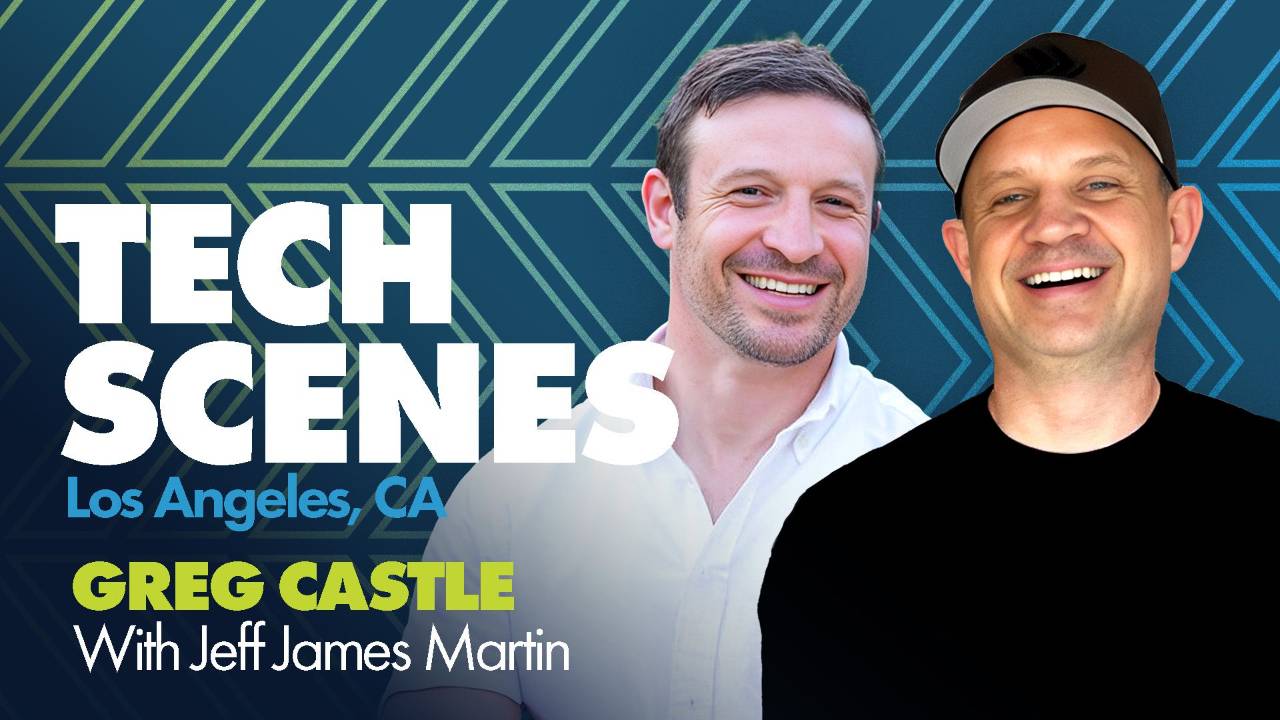
Greg Castle: He Bet Early on Oculus. Here’s What He’s Betting on Next.
“If you’re going to take a company from zero to multibillions of dollars in enterprise value, it takes an exceptional human.” - Greg Castle
Greg Castle is the Managing Partner of Anorak Ventures, an early-stage venture capital firm investing in transformational technology. An entrepreneur and corporate marketer turned venture capitalist, Greg has made more than 200 seed-stage investments, including Oculus, Flexport, Anduril, Flock Safety, Sesame, Onebrief, and Mux.
In this episode of Tech Scenes, Greg shares how meeting Palmer Luckey and investing early in Oculus changed the trajectory of his career—and shaped his conviction that the most compelling founders build technologies capable of fundamentally changing how people live and work.
Greg and Jeff explore what makes an exceptional founder, why scaling a company is a learned craft, and how the best leaders create learning loops throughout their organizations. They also discuss the emotional demands of entrepreneurship, the balance between confidence and arrogance, and why founders need environments where they can honestly confront what is not working.
The conversation then turns to the next wave of frontier technology. Greg explains why he is increasingly focused on reindustrialization and upstream manufacturing—including magnets, metals, chemicals, semiconductors, batteries, and other foundational materials. He also shares why he is more bullish on specialized robotics than humanoid robots and the three qualities he looks for when evaluating a CEO.
This is a candid conversation about venture capital, frontier technology, founder psychology, organizational execution, and the discipline required to build an outlier company.
CHAPTERS
00:00 What it takes to build an exceptional company
01:15 Welcome to Tech Scenes
01:20 The story behind Anorak Ventures
02:51 How Greg became an early investor in Oculus
05:20 How Oculus shaped Greg’s investment thesis
07:10 Defining frontier technology
09:01 Timing and founders who bend reality
11:09 Why scaling a company is a learned craft
13:08 Jiu-jitsu, humility, and organizational learning loops
18:56 Creating teams that confront what is not working
20:52 The emotional context switching required of founders
23:20 Confidence, arrogance, and the challenge of investor advice
28:26 Reindustrialization and upstream manufacturing
31:35 Investing in magnets, metals, chemicals, and semiconductors
33:43 Why Greg is skeptical of humanoid robots
36:46 Investing when the future is increasingly difficult to predict
40:01 The three qualities Greg looks for in a CEO
40:21 The best advice Greg has received
43:00 Greg’s desert-island album
LEARN MORE ABOUT GREG CASTLE AND ANORAK VENTURES
Anorak Ventures
https://www.anorak.vc/
Greg Castle
https://www.gregcastle.org/
Anorak Ventures on Crunchbase
https://www.crunchbase.com/organization/anorak-ventures-2
Greg Castle on Crunchbase
https://www.crunchbase.com/person/greg-castle
SEEKING INVESTMENT FROM ANORAK VENTURES?
Submit your company through Anorak Ventures’ investment form:
https://airtable.com/shrk0uJ7fET4Wm2ED
Related Insights
What Is Organizational Execution?
What Is Organizational Intelligence?
What Is a Business Operating System?
About the author
Jeff James MartinCEO and Founder, Collective Genius
Jeff James Martin is the Founder and CEO of Collective Genius, creator of Peak OS, and author of Peak Teams. He works with growth and mission-critical organizations to improve alignment, accountability, execution, and team performance. Over the past two decades, Jeff has helped hundreds of founders, executives, and leadership teams build stronger operating rhythms and scale through increasing complexity. He is also the host of Tech Scenes, where he interviews founders, investors, and operators on leadership, innovation, and organizational performance.
About Peak OS
Peak OS is the operating system for organizational execution. Designed for growth-stage and mission-critical organizations, Peak OS helps leadership teams align priorities, establish operating rhythm, improve accountability, and maintain visibility as organizational complexity increases. By creating a consistent framework for communication, planning, and execution, Peak OS helps teams reduce execution drift and turn strategy into measurable outcomes. Learn more: Collective Genius
About Collective Genius
Collective Genius helps founders, executive teams, and growing organizations improve organizational execution through leadership coaching, operating systems, strategic facilitation, and Team-of-Teams alignment. Our work focuses on helping organizations scale without losing clarity, accountability, communication, or momentum. Learn more: Collective Genius
About Peak Teams
Peak Teams: Mastering the Habits of Unstoppable Venture-Backed Companies explores the leadership habits, operating rhythms, accountability systems, and execution principles used by high-performing organizations. The book provides practical frameworks for leaders seeking to build aligned teams and execute consistently as complexity grows. Learn more: Peak Teams book
Learn More
Explore additional insights on organizational execution, operating rhythm, leadership, team alignment, business operating systems, artificial intelligence, and the future of work through the Collective Genius Insights platform. Visit: Collective Genius Insights
Episode Transcript
Jeff Martin in conversation with Greg Castle
“If you’re going to do something as crazy as take a company from zero to multi-billions of dollars in enterprise value, you’ve got to be exceptional.” — Greg Castle
This transcript has been lightly edited for clarity and readability. Repetition and obvious transcription errors have been cleaned up while preserving the substance and conversational tone. It contains occasional explicit language.
Cold Open — 00:00
Greg Castle: Entrepreneurship has become an area that so many people are excited about. So many people want to start their own companies. It's never been easier to start a company. There have never been more programs in existence. There's never been more private capital. If you're going to do something as crazy as take a company from zero to multi-billions of dollars in enterprise value, it takes such an exceptional human to build a company.
Jeff Martin: Looking back on all your experience, what is the best advice that you ever received? Welcome to Tech Scenes.
Greg Castle: Thank you.
Anorak Ventures and the Oculus Origin Story — 01:16
Jeff Martin: Thanks for joining me. Well, let's start from the top.
Greg Castle: Yeah.
Jeff Martin: Tell me about Anorak. Am I saying it right?
Greg Castle: That's right. Anorak Ventures.
Jeff Martin: And Anorak is something around when someone's obsessive about something, correct?
Greg Castle: It's somebody who is deeply interested—bordering on obsessive—in these subjects. It's kind of like a nerd. The word came from the fact that train spotters, who were kind of the original nerds over in Europe, would always be standing out in the rain counting trains, and they would be wearing anoraks. So it became a term to describe somebody who is obsessed.
Anorak is a term that's used much more widely in Europe, especially in the UK, in place of nerd. But it was also the main character's avatar in Ready Player One, and because my investing roots are seeded with an investment in a VR company, I liked the two meanings of the name.
I've been investing full-time since about 2014. That was when I left my day job, and I was able to do that because I was an early investor in Oculus.
Jeff Martin: How did you get involved in Oculus?
Greg Castle: There were a couple of people who worked in the video gaming industry who had heard about a kid working on a virtual reality headset. That kid was Palmer Luckey, and I met him with a few of the co-founders—Brendan, Nate, and Michael.
We took him out to dinner. He was considering taking a job at Sony to lead their VR efforts, and we had a long conversation about his aspirations and what he wanted to do. The conversation evolved into: what if you started your own company? What if you had funding and the right people around you to do it?
That was the founding of Oculus. Palmer was already working on a headset, and Brendan, Nate, and Michael really helped create a business and stand the company up.
Because of my relationship with the guys, I essentially had a front-row seat to what happened there, and it was an amazing thing to witness. They brought a brand-new technology to market. It was amazing to see how they did it, what worked, and what didn't.
I'd always been excited about innovation, but seeing it firsthand was incredibly inspiring. When they ended up selling to Meta, I had the capital to see what it would be like to do this on a full-time basis—to help companies bring new technologies to market and to invest more.
I took a stab at it and did it for a couple of years on my own. I made a bunch of mistakes, and I also made a couple of investments that worked out very well.
From 2014 through the end of 2016, it was all me angel investing and doing a couple of SPVs. Eventually, I'd made enough additional investments to prove to myself that Oculus wasn't just a fluke, so I institutionalized it and created the first fund.
How Oculus Shaped an Investment Thesis — 05:20
Jeff Martin: How did the Oculus experience shape your investment thesis?
Greg Castle: It really opened my eyes to what happens when you're building something that's genuinely exciting to people. At the end of the day, we're all consumers—whether you're talking about investors, enterprise customers, or the general public. Everybody is subject to the same types of excitement and passion.
If you can ignite that, it kind of works across the board.
Seeing the reaction people had to VR technology and to what Oculus had built was so exciting to me that it became what I wanted to do going forward.
I wanted to discover more technologies that were going to wow people. The idea of going back and working at a company building HR software or SaaS software just didn't appeal to me.
My eyes had been opened to what it was like to bring a brand-new technology to market and see how you could attract investors, amazing talent, and customers all aboard. That's what I wanted to devote the rest of my life to.
We've always been chasing those types of opportunities and those types of visionary founders since I started investing.
What Counts as Frontier Tech? — 07:10
Jeff Martin: So, well over a decade investing in frontier tech. How do you define frontier tech?
Greg Castle: Generally, when I talk about the types of things we invest in, it's really one of two things.
Either you're developing a breakthrough innovation yourself—think fusion energy, new forms of manufacturing, quantum computing—areas where a real scientific breakthrough is required to bring the product to market. At first, many of these things seem more academic. That's one bucket of frontier tech.
The other bucket is nascent technologies that are more well understood and perhaps have applications in other industries. In that case, the innovation is less in the technology itself and more in its application to that industry.
Jeff Martin: I learned that quickly in the '90s the first time we did some fundraising with a company I worked with. We were doing handheld mobile technology—basically software on a Palm Pilot, the PalmOne.
What I realized quickly is that you could almost have two wheels: spin the technology, spin the industry, blend them together, and ask, “How can we use RFID with healthcare?” That's what you're talking about in that fashion.
Greg Castle: Exactly.
Jeff Martin: But when we're talking about real tech innovation—hard innovation—it's very different.
Greg Castle: It is very different.
Jeff Martin: And the complexity and the hard part is timing, right?
Timing, Exceptional Founders, and the Craft of Scaling — 09:01
Greg Castle: Yes. Absolutely. Timing is extremely difficult to get right.
In some ways, you need to get the timing directionally right, and you also need to be an Anorak. You need to be incredibly passionate and be one of these founders who can help shape reality—bend reality to their will—even if the timing is slightly off.
It's funny: entrepreneurship has become an area so many people are excited about. So many people want to start their own companies. It's never been easier to start a company. There have never been more programs in existence. There's never been more private capital.
But it takes such an exceptional human to build a company.
Part of that is the founder's ability to bend reality to their will.
If something isn't the way it should be right now—whether you're talking about legislation, consumer sentiment, or whatever—it takes incredible determination, perseverance, and work ethic to help bend and change it.
It's not easy. It's not cheap.
If you're going to do something as crazy as take a company from zero to multi-billions of dollars in enterprise value, you've got to be exceptional. You've got to be crazy in some ways.
It's just a very, very difficult thing to do.
I love seeing all these people who want to get into entrepreneurship, but the characteristics and personality it takes to do it really successfully are one in a million.
Jeff Martin: And that's where I enter. Execution is everything—people say that all day long—but I think it's really interesting that when people make investments, they spend very little time understanding whether the founder and the current team can actually execute.
There's very little done in that space, and it astonishes me.
I've worked with hundreds of teams to help them execute and build operational intelligence, leveraging systems that I think matter from day one—from the start of a company all the way to exit.
It takes a very unique founder to understand the craft of scaling. I think it is a craft. You can have some intuitiveness, but you have to learn a lot to really scale a company.
Greg Castle: Yeah. I think the skill is in the learning: being able to surround yourself with great people, process massive amounts of information, distill it down, and execute on it.
I don't think that skill is innate. That scaling muscle is not a muscle you can simply read about.
I think you need to have a certain personality, and I think being around people who know what it looks like, tastes like, and smells like to scale a company—people who are used to that ramp or have had exposure to it before—is incredibly important.
Jiu-Jitsu, Humility, and Organizational Learning Loops — 13:08
Jeff Martin: It's going to be impossible to stay away from jiu-jitsu analogies here, but one of the most important things jiu-jitsu taught me is the art of learning.
You're constantly in a rapid learning environment, surrounded by other people who are also in a rapid learning environment.
You're learning paths and finding where paths fail and why they fail. You're asking other people. Someone will do something to you and you'll say, “Wait, how did you do that?”
Or you'll watch something happen and you can't stop it.
I think of those as learning loops within organizations. Good founders have learning loops—they learn.
But when they branch from one team to a team of teams, the best founders understand they have to create those learning loops in the organization.
That's where a lot of great founders who are good at learning start to fail: they don't create the systems that allowed them to win when they were smaller.
Greg Castle: Yep, I completely agree.
There are so many reasons why I like to roll—why I like jiu-jitsu particularly.
The perseverance and the strength required, more mental than physical, is something I train every time I'm there. That ability to get hit and keep coming. The ability to get tapped and continue the rest of the session with positivity and enthusiasm.
And also the humility—to your point—of knowing you don't know everything and trying to learn every time.
Anthony Bourdain had a comment along the lines of, “I just try to go there and suck a little bit less every time.”
Jeff Martin: Anthony Bourdain.
Greg Castle: I try to go to every session and just suck a little bit less every time.
It is humbling every time you go in there. Part of that is putting your beginner hat on every time, not being too proud to ask questions, and just staying humble.
Jeff Martin: Right. I think it's interesting. I've done jiu-jitsu for years, but I also coach wrestling.
What's astonishing about jiu-jitsu is that you can take an unathletic person and they can become athletic. I've never really seen that in any other sport.
You can take someone who has never done any sports before. They don't have confidence. They don't know what's going on. But they stick with it, keep doing it, and become really good.
They will destroy athletic people who don't know as much.
Greg Castle: Yep.
Jeff Martin: But I've never seen a person who's just not athletic figure out how to play basketball and become really good at it. That just doesn't happen.
I think the same is true with wrestling, but wrestling is a little more aggressive, so it's harder to break through that threshold.
Greg Castle: Yeah.
Jeff Martin: When I work with early jiu-jitsu people or younger wrestlers, I keep telling them it's a path.
Each move is a path to another move. It may get stopped, and if you're successful it leads you into a different position. Then something else can happen and you end up in another position.
It's like building a path through the woods.
The more you go through that path, the wider it gets, the easier it gets, and the more nuances you know about every part of it.
I think organizations are the same way.
When you get stuck on something, it's like jiu-jitsu: you can't try to learn everything all the time. You'll never have success.
You have to narrow down where you want to focus your energy and time.
Is the problem product? Go-to-market? What's holding us back?
Focus the team around that.
I think it's a very similar analogy.
Greg Castle: There's that phrase: soccer is a gentleman's sport played by hooligans, and rugby is a hooligan sport played by gentlemen.
I generally feel as though people who engage in more violent or battle-focused sports tend to be more humble and have more respect.
I don't know why that is.
You could argue that when you're proving yourself physically on a fairly regular basis, you don't feel like you have a lot to prove, so you can have more inner confidence.
At least that's how it feels to me.
I love that inner confidence jiu-jitsu gives me. When I meet investors or founders who roll, or who wrestled in the past, there's a kind of understanding between us.
Founder Transparency, Confidence, and the Weight of Advice — 18:56
Jeff Martin: Well, there aren't too many sports where you actually submit to somebody physically—literally—and doing that over and over again humbles you.
I meet a lot of people who put up a front: “How's everything going?” “Everything's going great.”
And you're like, no, that can't always be true.
There are things you're working on and challenges you're facing.
You see a lot of that, especially in founders and some of their team members, because there aren't a lot of safe places to go.
You can't always talk about the things that are bad and not working because you're selling everybody on the vision—from investors to partners to customers to employees. You have to be confident.
But there is a balance.
When I'm with teams, one of my first roles is to create a transparent, equal environment where we can talk about the things that are not working.
If we're going to get ahead, we have to be open about those things.
I use the analogy of climbing mountains for Peak and what we do. It's like carrying boulders of issues in your backpack while trying to hike the mountain.
Take those things out and deal with them.
A lot of people have a hard time feeling like they have the right environment to do that.
I think it's important that teams create those environments.
There's still a hierarchy of decision-making, so it's not completely equal, but if you're not dealing with that stuff, you're not going to succeed.
I'm curious: looking back at Oculus going from zero to success, how did they go from that vision to execution?
Greg Castle: I just want to comment on something you said beforehand.
I was an entrepreneur before I got into venture, so I had my own business for six years.
Toward the end, it was not going well, and I remember sitting there opening overdue bills while receiving phone calls from potential investors about the concept.
The context switching that founders need to go through—between dealing with the hard things and trying to sell the vision—is so challenging.
Some people are better at compartmentalizing than others.
I can see why some founders have the ability or desire to always stay super-positive and put up this front.
They do that in some ways for protective purposes, because going open-kimono and talking about all the things that are bothering them when they know the next day they have a board meeting where they have to present a positive front can be super challenging.
I don't know that there's one right way to deal with it.
I certainly don't think keeping it completely bottled up the whole time is the right way to go.
Different people handle that context switching and compartmentalization in different ways.
I often say that the best founders I've invested in toe the line between confidence and arrogance, and it's a very, very thin line.
It's very easy, when you're confident, to appear arrogant.
Founders need a bit of that edge—a little bit of arrogance in the right places.
Maybe arrogance isn't the right word.
Jeff Martin: Just confidence.
Greg Castle: Yeah—unwillingness, irrational positivity, I guess, is another way to put it.
Jeff Martin: I see it too.
I'm involved with so many teams that I see a lot of signals.
Someone might want to have a long conversation about something and I'm thinking, I've seen this work 87 times and that never worked.
Sometimes people can look arrogant because they simply have so much more knowledge and data in that situation.
We don't need to spend a lot of time discussing it.
Greg Castle: I think you're absolutely right.
Jeff Martin: I'm sure you have moments like that too. You're just like, “I don't have the energy or time to have that conversation.”
Greg Castle: I'll tell you what the difficulty is with me as opposed to you.
I get concerned when I give advice—especially advice that can look self-serving—because I'm an investor.
The example that comes up all the time is speaking to a founder I'm excited about who I think is raising at too high a valuation.
I think ultimately it's going to turn some investors off, send the wrong message, and perhaps they're doing it for the wrong reasons.
I believe that advice is in the best interest of the company and the founder.
Jeff Martin: Yep.
Greg Castle: But at the same time, they're looking at it and saying, “Of course you want a better valuation. Of course you would say that.”
Oftentimes I give advice that is both in my best interest and in the best interest of the founder, but the founder's skepticism will pick up on: “This guy is a sharky investor. Of course he wants that.”
If you've worked really hard to build a strong rapport with your founder, they should know better.
That's different from the position you're often in, where you're being paid to work with the company and provide the best help you can.
There's no ulterior motive.
Jeff Martin: That's interesting.
I can understand how difficult that situation is: you're giving them the best advice and it's clear to you, but it can send a different signal.
Greg Castle: Even more so, this is all I do day in and day out.
You can read what you want in TechCrunch about funding announcements, but those are the exceptions—that's why they're getting press coverage.
Every day I'm speaking to founders.
I have infinitely more signal than they do in terms of what's working in the market and the prices people are paying.
There's a tremendous information asymmetry as well.
Jeff Martin: Yep.
What's unique about what I do—and it's probably often misunderstood—is that I actually give zero advice.
What I'm typically doing is helping teams define focal points: Where do we want to be three years out? How are we going to get there? Why do we want to do that?
I'm facilitating those conversations around a three-year vision, a one-year plan, helping them through OKRs, aligning them team-to-team, and creating focus and alignment.
Where I do teach is the system, the cadence, the rhythm, the review, and how to collect that learning loop.
When I'm asked about something, I share relevant experience.
I can say, “This is what I've seen. I'm not telling you what to do, but this is what I've seen, and you can decide what to do with that.”
If they're talking specifically about friction between product and engineering, or sales, or whatever, I'll share what I've seen work best—for example, get the teams together, because typically it's a lack of understanding rather than a lack of willingness to work together.
But if they're debating whether they're going to do $110 million or $105 million by the end of the year, I wouldn't jump in and say, “I think it's going to be $130 million, guys.”
I get out of the way of that.
Relevant experience helps.
I think you're only as good as the one time you tell them to do something bad if you're a consultant, and I just don't like that type of work.
Greg Castle: Yeah, I completely agree.
That's generally how I try to help: relevant experience.
“I've seen this multiple times. This is what could happen.”
Where Frontier Tech Is Going: Upstream Manufacturing — 28:26
Jeff Martin: Basically, you're providing inputs that help them make decisions.
I want to change the conversation a little bit.
Looking at the current frontier tech scene, what are you excited about? What are you seeing that you're excited about?
Greg Castle: Where we've been spending more time recently is upstream manufacturing—going further upstream into raw materials: metals and alloys, magnets, chemicals.
We've been investing in hardware product companies for years, and recently geopolitics have heated up.
We saw the impact of supply-chain disruptions during COVID, and I think there's a real opportunity now.
When we talk about reindustrialization, market dynamism, and ensuring that critical hardware can be made here or among our allies, our manufacturing capabilities—both ours and our allies'—have been hollowed out over the last several decades.
These are all the talking points for American Dynamism.
What I'm realizing more and more is that, yes, there are a bunch of sexy problems that are more Silicon Valley-esque.
You can create the next lights-out advanced manufacturing facility.
You can create the next drone company.
But the problems are upstream: can these product companies actually produce the thing?
Jeff Martin: And can they create the margins that we used to see in SaaS?
Greg Castle: Exactly.
Jeff Martin: Right.
Greg Castle: I don't know whether they'll ever be able to compete with those types of margins, but we're already seeing public markets pulling back from SaaS, and have been for a while.
I think we're going to see more excitement for companies building physical things that have tremendous room for growth, even if they don't have the same margin profiles as SaaS companies.
Jeff Martin: Is SpaceX a good example of that—the excitement and the value the market places on it?
Greg Castle: Exactly.
Reindustrialization and American Dynamism are big themes that a lot of investors are talking about and excited about.
I'm excited about those as well, but I'm also very excited about what's happening upstream from those efforts.
Jeff Martin: What kind of investments would be upstream?
Greg Castle: Magnets, steel, chemical production, PCBs, semiconductors, battery manufacturing.
Jeff Martin: Does that excite you?
Greg Castle: Yeah, it does.
Believe it or not, it's interesting.
These are massive industries that haven't seen significant disruption for years.
If you were going to create a Dow Chemical company today from a blank sheet of paper, what would that look like?
It would look so different.
The ability to produce things more cleanly, to produce novel materials faster, and bring them to market—these are the core building blocks of our civilization.
Jeff Martin: Just speed alone would be such a change.
Greg Castle: Yeah.
These are thorny problems that require deep expertise.
Many of them will require a fair amount of capital, so dilution and capital efficiency are big considerations for us as investors.
Oculus was kind of the exception, but aside from that I've always liked these “unsexy” opportunities in business—not the company building the next canned beverage, but the company building the next can or the next novel material that's going to go in that can.
Why Greg Is Bearish on Humanoid Robots — 33:43
Jeff Martin: What's hot in frontier tech right now that you're just not into—that you're bearish on?
Greg Castle: Humanoid robots.
Jeff Martin: Why is that?
Greg Castle: I just think there's a lot of hype.
The companies in the space are very frothy and have raised at enormous valuations that I think will be difficult to grow into.
If you're going to design systems and technology to solve specific problems, the human form factor is not going to be the best form factor for a whole bunch of those problems.
I'm much more bullish on specialized robotics than I am on humanoid robots.
Why create a human to work in a factory?
There are better form factors.
We are not optimized to work in a factory.
We were designed to forage and hunt and do shit like that—not fucking lift pallets and work on an assembly line.
So I think it's sexy, I think it's cool, and so do investors, obviously.
I'm just bearish on it.
Jeff Martin: I think that's a really good argument.
Why create it in that form when you could create it in a form that would be much more efficient and effective?
Greg Castle: If you're going to create the best soldier out there, are you going to create the best soldier with two arms or four arms? With two legs or tank treads?
All of these different use cases have specialized requirements—or should use specialized form factors—and I just don't know what you're designing the humanoid robot for.
Everything I've seen in humanoid robots is underwhelming.
They can do martial arts.
I was at CES this year and saw probably two dozen different humanoid robot companies all showing how they could do laundry, and none of them were any good at it.
Jeff Martin: You know what does laundry really well? A washing machine.
Greg Castle: Yeah, a washing machine.
And that's the other thing: dishes.
I've been infatuated with the dish problem for years.
If you're going to design something to handle dirty dishes, are you going to design a humanoid robot from scratch that can grab the dish, use the sink, blah, blah, blah?
Or are you going to design a specialized machine where you can literally take a plate, slide it in like an old CD player, it cleans it, it stacks it, and that's where your dishes live going forward?
You'd design a specialized machine just to handle that problem.
Jeff Martin: That's it.
Greg Castle: That's what I want.
And I'm looking for that investment.
If anybody is working on a specialized dishwasher where you can just throw in your utensils, cups, and everything else, that's what I want.
Investing When the Future Is Harder to See — 36:46
Jeff Martin: It already was designed on The Jetsons.
Some things are really easy to see coming in the future—like the iPhone.
I was working on mobile stuff very early, and the idea of all of this being on your phone was very obvious.
With AI today, that dynamic has changed because now we have something that, in a way, is smarter than us.
It makes the future harder to understand.
As an investor, how do you look at it?
How do you make your thesis when things are harder to see?
Greg Castle: My job is to go out, speak to as many people as possible, understand as many problems as I can, and try to find founders who are building toward the future that I see and fixing some of the problems I'm seeing and researching.
I think back to what we were discussing about how exceptional a founder has to be to create an outlier company.
I also rely a lot on founders to educate me and get me excited about different problems—to take me along on a journey and tell me a story that brings me in and gets me excited about something I then want to help solve.
If they can do that for me, they can do it for other investors, hires, and customers.
There are two sides to it.
On the proactive side, my partner and I want to go out, understand problems, and form beliefs about where we think the world is going.
What are the main problems facing society right now?
What are potential solutions?
Then we want to meet as many founders as we can in and around those spaces.
We're going to say no to a bunch of people working on things we just don't find interesting, fascinating, or impactful.
But within the areas we believe are going to matter, we want to meet as many founders as possible and find the exceptional founders who are going to make us believe.
Jeff Martin: It's no different from an organization.
You're surrounding yourselves with the space you want to solve and putting your focus and energy into that space, making decisions about how to leverage capital to solve those problems.
I see the same thing with a CEO looking at an organization.
You only have so much capital.
Where are we going to put it?
You have a finite amount of resources, including capital and energy—which is your people.
Greg Castle: Yep.
Jeff Martin: And it's on a timeline.
Three Traits Greg Looks for in Founders — 40:01
Greg Castle: One hundred percent.
The three characteristics I look for in CEOs are:
Can you set a vision people are going to believe in?
Can you attract the right talent?
And can you raise money?
If you can do those three things well—hire, make sure the company doesn't run out of money, and set a vision everybody believes in—that's the type of founder I want to invest in.
The Best Advice Greg Has Received — 40:21
Jeff Martin: Looking back on all your experience, what is the best advice you ever received—something that pops back into your head over and over again while you operate?
Greg Castle: I think spending time on the things I'm good at and passionate about, and trying to delegate or not spend too much wasted energy in areas where my heart isn't, is what guides a lot of how I spend my time.
When I'm thinking about how I manage my time, I'm really thinking: How do I build systems to offload as much of the stuff I don't enjoy as possible?
Jeff Martin: Right.
Greg Castle: So I can spend more time on the stuff I do enjoy—the stuff that fills me up.
That discipline around your time and where you focus your attention has been very useful and has guided a lot for me.
Jeff Martin: That makes a lot of sense because when you talk about investors and founders, you're also looking for founders who can build teams—who can get the right people around them so they can focus their energy on doing the things they're best at.
Greg Castle: Absolutely.
Jeff Martin: That's definitely hard.
Even if you choose the right people, it's hard for founders to let go of certain things they're passionate about and want to work on—even when the company starts to outgrow them in that role.
Greg Castle: There are great founders who are super technical and enjoy certain things on the technical side, but they've had to let go because if they're the ones spending time on a difficult technical problem, who the heck is running the company, setting the vision, and getting everybody pumped?
It's super important.
I also think hiring people who have done it before can be a real hack, as opposed to bringing in somebody who's simply excited or somebody you've known for a long time who wants to get into the space.
Especially on the sales side, somebody who already has a book of business and the right contacts can be a real unlock.
The Desert-Island Album — 43:00
Jeff Martin: Last question.
I ask this all the time—the most important question anyone asks in life.
It's more of a scenario.
You're trapped on a desert island for the rest of your life. It's a beautiful tropical island. You have everything you need: food, water, healthcare—whatever you need.
The only thing you don't have is entertainment.
Luckily, an old '80s boombox has drifted to shore, but you can choose only one album to listen to for the rest of your life.
What album are you listening to?
It doesn't have to be from the '80s. It can be any genre.
Greg Castle: Goddamn. I mean, my first—
Jeff Martin: You answered everything else so quickly.
Greg Castle: My first instinct would be a Pearl Jam album.
Jeff Martin: Okay.
Greg Castle: But then, I don't know.
Eric Clapton Unplugged holds a very special place in my heart.
That was me growing up.
Jeff Martin: It's a great album. That's a flawless album.
Greg Castle: Yeah.
I'd probably go with that one because there are so many sides to that album.
There's the slow, chill side, and there are also some great upbeat tracks that just make you happy.
So I'd probably go with Eric Clapton Unplugged.
Jeff Martin: All right, awesome. Thanks for joining me on the show.
Greg Castle: Thanks for having me, man.
