
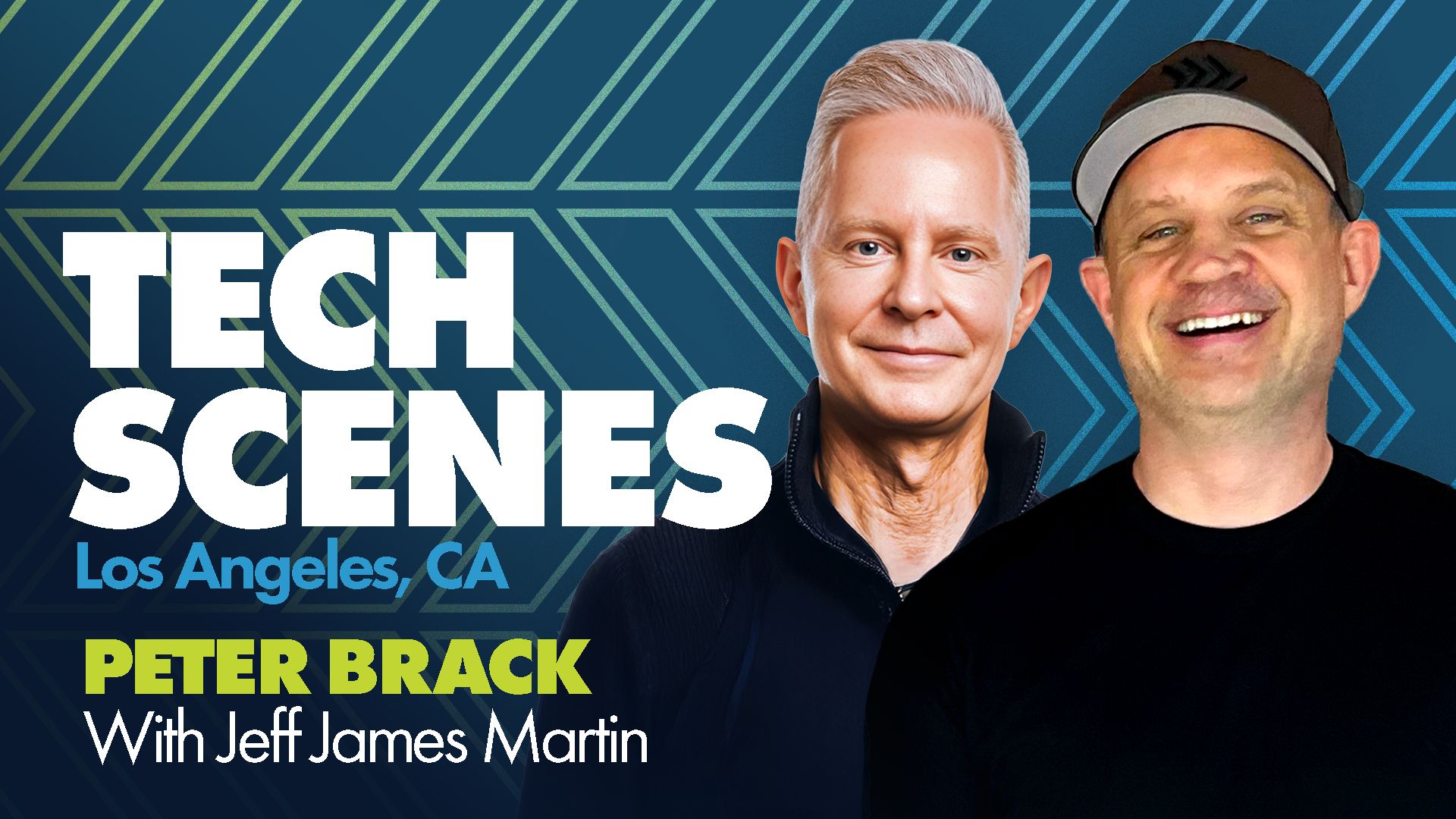
Tech Scenes Beverly Hills with Peter Brack
Tech Scenes Beverly Hills with Peter Brack: Episode Summary and Key Takeaways
Many entrepreneurs successfully build companies.
Far fewer successfully make the transition from founder to CEO.
In this episode of Tech Scenes Beverly Hills, Collective Genius Founder Jeff Martin sits down with executive coach Peter Brack to explore one of the most important—and often overlooked—challenges in entrepreneurship: learning how to become the leader your organization needs as it scales.
Drawing on his experience as a founder, public company CEO, venture investor, and executive coach, Peter shares lessons from working with founders navigating rapid growth, organizational complexity, leadership challenges, hiring senior executives, and the realities of leading through uncertainty.
This conversation is ultimately about leadership as a craft. While many founders start companies through instinct, vision, and determination, scaling organizations requires a different set of skills. As Peter explains, becoming a CEO is not simply a title. It is a discipline that must be learned, practiced, and continuously refined.
Watch and Listen
Watch the Full Episode on YouTube
Listen on Spotify
https://open.spotify.com/episode/13gZXRdyoJe45MGcNl8C0l?si=5tC__XnfSGG91vo9_Emu0g
Episode Overview
Peter Brack works with founders and CEOs at critical moments of organizational growth. His coaching practice focuses on helping founders evolve into leaders capable of guiding increasingly complex organizations.
During the conversation, Peter reflects on his own journey as a founder and CEO, including building and taking companies public, navigating co-founder dynamics, managing organizational growth, and ultimately discovering a passion for helping other leaders navigate similar challenges.
Throughout the discussion, several themes emerge repeatedly: leadership development, fear, delegation, trust, founder identity, organizational scale, and the importance of creating space for thoughtful decision-making.
One of Peter's central beliefs is that becoming a CEO is not something that happens automatically when a founder receives a title. It is a process of learning, growth, and intentional practice.
Founder Is a Title. CEO Is a Craft.
One of the most powerful insights from the conversation is Peter's distinction between being a founder and being a CEO.
Many founders assume that because they successfully started a company, they naturally know how to lead it through every stage of growth.
Peter challenges that assumption.
Founding a company and leading a company are related but fundamentally different responsibilities.
The skills required to identify an opportunity, launch a business, build an early product, and secure initial customers are often very different from the skills required to lead hundreds of employees, manage executives, communicate with boards, navigate acquisitions, and scale an organization.
Peter describes the CEO role as a craft.
Like any craft, it requires deliberate practice.
It requires learning.
It requires reflection.
And it requires the humility to recognize that instinct alone eventually becomes insufficient.
The leaders who continue to grow are often those who treat leadership as a skill that can be developed rather than a trait they either possess or do not possess.
Why Scaling Creates New Leadership Challenges
As organizations grow, the demands placed on leaders change dramatically.
A founder leading a team of ten faces very different challenges than a CEO leading a company of one hundred, five hundred, or thousands of employees.
Peter explains that many of the leaders he works with reach an inflection point after a major funding round, acquisition opportunity, or period of rapid growth.
At that moment, the organization begins demanding something different from them.
The systems that worked previously no longer scale.
The communication patterns become strained.
The decision-making burden increases.
New layers of leadership emerge.
The founder who once made every important decision personally must learn how to build systems that allow others to make decisions effectively.
For many leaders, this transition can feel uncomfortable because success often requires letting go of the very behaviors that created early success.
The Hidden Role Fear Plays in Leadership
One of the most insightful moments in the episode centers on fear.
Peter observes that many leaders are driven by fears they have not fully articulated, even to themselves.
Fear of failure.
Fear of letting employees down.
Fear of disappointing investors.
Fear of making the wrong decision.
Fear of losing control.
Fear is not unusual.
In fact, Peter argues that it is almost inevitable.
Every stage of growth introduces new challenges and unfamiliar situations.
The first fundraising round.
The first executive hire.
The first board meeting.
The first acquisition.
The first organizational restructuring.
The first major crisis.
No founder begins their journey knowing how to navigate all of these experiences.
The challenge is not eliminating fear.
The challenge is ensuring fear does not become the primary driver of leadership decisions.
As Peter explains, leaders who operate exclusively from fear often struggle to lead strategically.
The most effective leaders acknowledge uncertainty while remaining focused on long-term outcomes.
Why Coaching Matters
Throughout the conversation, both Peter and Jeff emphasize the importance of creating space for reflection.
Founders spend much of their time solving problems for everyone else.
Employees need guidance.
Customers need support.
Investors need updates.
Partners need decisions.
Boards need answers.
Over time, many leaders find themselves carrying tremendous responsibility while rarely creating space to think about their own development.
This is where coaching becomes valuable.
Peter describes his role less as someone who provides answers and more as someone who helps leaders ask better questions.
A great coach is not there to run the company.
A great coach helps leaders develop the capacity to lead more effectively.
Often this means helping leaders think through decisions, identify blind spots, challenge assumptions, and create the space necessary to make thoughtful choices.
For founders operating in high-pressure environments, that support can become incredibly valuable.
You Don't Need to Be the Smartest Person in the Room
One of the most practical lessons from the episode involves hiring and delegation.
Many founders eventually reach a point where they need to hire experienced executives with far deeper expertise in specific domains than they possess themselves.
For first-time founders, this can feel intimidating.
Suddenly they are managing people who have spent decades developing expertise in finance, operations, product development, sales, marketing, or engineering.
Peter believes this discomfort is natural.
However, he also argues that one of the most important leadership breakthroughs occurs when founders stop trying to be the smartest person in every room.
Great leaders surround themselves with exceptional people.
They create environments where expertise can flourish.
They delegate responsibility.
They trust others to perform.
They focus on creating alignment rather than controlling every decision.
Leadership is not about knowing everything.
Leadership is about creating the conditions where great people can do their best work.
Why Leadership Becomes More Important as Companies Scale
As organizations grow, leadership increasingly shifts from direct execution to creating clarity.
Peter and Jeff discuss the importance of helping leaders develop systems that can scale beyond individual effort.
A founder may personally drive execution in the earliest stages.
A larger organization requires something different.
Clear priorities.
Strong communication.
Effective delegation.
Leadership development.
Accountability.
Organizational trust.
These systems become increasingly important as organizations grow more complex.
Without them, growth often creates confusion rather than momentum.
The strongest organizations are not built around heroic individuals.
They are built around leadership systems that help teams perform consistently.
Why Having Someone Along for the Journey Matters
Toward the end of the conversation, Peter reflects on what coaching really provides.
His answer is surprisingly simple.
Presence.
Many leaders do not need someone to tell them what to do.
They need someone who understands the journey.
Someone who understands the pressures, challenges, and responsibilities that come with leadership.
Someone who can help them think clearly when complexity increases.
Someone who can create a trusted space for reflection.
Leadership can be isolating.
Having a trusted partner who can help navigate difficult decisions often makes an enormous difference.
For Peter, that may be one of the most valuable aspects of coaching.
Key Quotes from Peter Brack
"I help founders become CEOs."
"Founder is a title. CEO is a job."
"The role of the CEO is really a craft."
"If you're always leading from a place of fear, then you're not really leading from a place of strategy."
"You don't need to be the smartest person in the room."
"Once you realize you want to be surrounded by people who are smarter than you, that's when you can really start running fast."
"Leadership isn't taught. Most people are learning it in real time."
Key Takeaways
-
Founding a company and leading a company require different skills.
-
Leadership should be viewed as a craft that develops over time.
-
Fear is a common but often unspoken part of leadership.
-
Executive coaching helps leaders create space for reflection and growth.
-
Great CEOs do not need to be the smartest people in the room.
-
Delegation becomes increasingly important as organizations scale.
-
Leadership systems matter more as complexity increases.
-
Organizational growth requires founders to evolve continuously.
-
Strong leaders focus on clarity, trust, and alignment.
-
The best CEOs commit to learning throughout their careers.
Frequently Asked Questions
Why do founders struggle to become CEOs?
The skills required to start a company are often different from the skills required to scale and lead a growing organization.
What does an executive coach do?
Executive coaches help leaders improve decision-making, self-awareness, leadership effectiveness, and organizational performance.
Why is leadership difficult during periods of growth?
Growth creates new responsibilities, new challenges, and new levels of complexity that often require different leadership approaches.
Why do founders struggle with delegation?
Many founders built their companies through direct involvement and must learn to trust others as organizations scale.
How can CEOs overcome fear?
By recognizing fear, creating space for reflection, seeking trusted advisors, and focusing on long-term strategic thinking.
Why is hiring experienced executives challenging for founders?
Many founders must learn how to lead people with deeper expertise in specific areas than they possess themselves.
What does it mean to treat leadership as a craft?
It means viewing leadership as a skill that requires continuous learning, practice, and improvement.
Why is coaching valuable for CEOs?
Coaching provides support, accountability, perspective, and a trusted environment for discussing complex challenges.
Why This Conversation Matters
Many discussions about entrepreneurship focus on fundraising, product development, growth, or technology.
This conversation focuses on something even more fundamental.
Leadership.
Organizations rarely fail because founders stop caring.
More often, organizations struggle because the leadership systems that worked at one stage no longer work at the next.
Peter's perspective offers an important reminder that scaling companies requires leaders to evolve alongside their organizations.
The founders who embrace leadership as a craft often create stronger companies, healthier cultures, and more sustainable growth.
Related Insights
What Is Organizational Execution?
What Is Organizational Intelligence?
What Is a Business Operating System?
About the author
Jeff James MartinCEO and Founder, Collective Genius
Jeff James Martin is the Founder and CEO of Collective Genius, creator of Peak OS, and author of Peak Teams. He works with growth and mission-critical organizations to improve alignment, accountability, execution, and team performance. Over the past two decades, Jeff has helped hundreds of founders, executives, and leadership teams build stronger operating rhythms and scale through increasing complexity. He is also the host of Tech Scenes, where he interviews founders, investors, and operators on leadership, innovation, and organizational performance.
About Peak OS
Peak OS is the operating system for organizational execution. Designed for growth-stage and mission-critical organizations, Peak OS helps leadership teams align priorities, establish operating rhythm, improve accountability, and maintain visibility as organizational complexity increases. By creating a consistent framework for communication, planning, and execution, Peak OS helps teams reduce execution drift and turn strategy into measurable outcomes. Learn more: Collective Genius
About Collective Genius
Collective Genius helps founders, executive teams, and growing organizations improve organizational execution through leadership coaching, operating systems, strategic facilitation, and Team-of-Teams alignment. Our work focuses on helping organizations scale without losing clarity, accountability, communication, or momentum. Learn more: Collective Genius
About Peak Teams
Peak Teams: Mastering the Habits of Unstoppable Venture-Backed Companies explores the leadership habits, operating rhythms, accountability systems, and execution principles used by high-performing organizations. The book provides practical frameworks for leaders seeking to build aligned teams and execute consistently as complexity grows. Learn more: Peak Teams book
Learn More
Explore additional insights on organizational execution, operating rhythm, leadership, team alignment, business operating systems, artificial intelligence, and the future of work through the Collective Genius Insights platform. Visit: Collective Genius Insights
Music by Andrew Applepie - https://soundcloud.com/andrewapplepie
