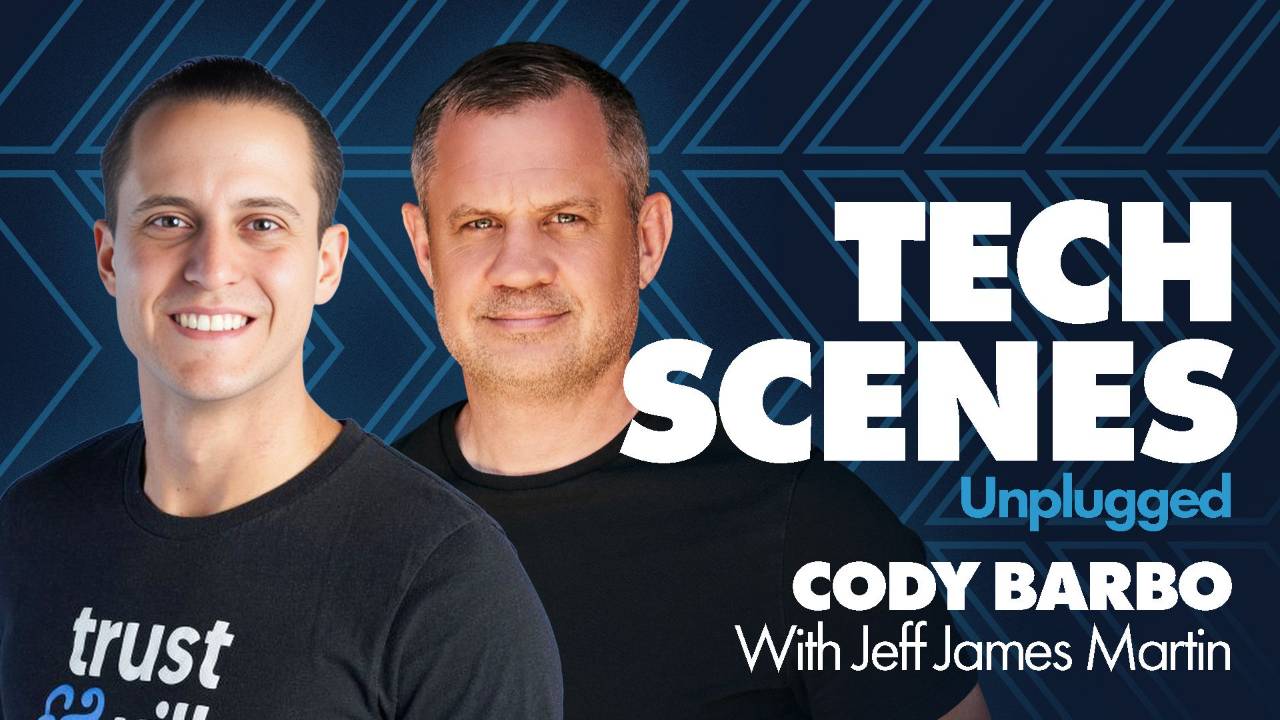
Tech Scenes Unplugged with Cody Bardo, CEO and Co-founder of Trust & Will
Tech Scenes Unplugged with Cody Barbo, CEO and Co-Founder of Trust & Will: Episode Summary and Key Takeaways
Building a startup is difficult.
Building a category-defining company is even harder.
In this episode of Tech Scenes Unplugged, Collective Genius Founder Jeff Martin sits down with Cody Barbo, CEO and Co-Founder of Trust & Will, to discuss entrepreneurship, scaling companies, operating systems, AI transformation, leadership, organizational design, and what it takes to build a mission-driven company in a category most people never think about until they absolutely need it.
What begins as a conversation about estate planning quickly evolves into a deeper discussion about startup growth, founder evolution, leadership systems, AI-native organizations, and the realities of scaling from a small team in a coworking space to a company serving hundreds of thousands of customers.
For founders, operators, executives, and investors, this episode provides an honest look at what happens when a company grows beyond its original systems and why successful organizations must continuously reinvent themselves as they scale.
Watch and Listen
Watch the Full Episode on YouTube
Listen on Spotify
https://open.spotify.com/episode/6QAiITmnHpoIsJjkDes858
Episode Overview
Cody Barbo co-founded Trust & Will in 2017 with a mission to make estate planning more affordable, accessible, and user-friendly for everyday families.
Inspired by personal experiences navigating probate and witnessing the challenges families face when proper estate planning is not in place, Cody and his co-founders recognized an opportunity to modernize an industry that had remained largely unchanged for decades.
Since launching, Trust & Will has grown from a startup operating out of a coworking space into one of the leading digital estate planning platforms in the United States, helping hundreds of thousands of families create wills, trusts, healthcare directives, and estate plans.
Throughout the conversation, Cody shares lessons from raising venture capital, building teams, scaling operations, creating organizational systems, working with enterprise partners, adopting AI, and preparing a company for long-term growth.
Building a Mission-Driven Company
One of the most compelling aspects of Trust & Will's story is that it began with a deeply personal problem.
Cody explains that his wife's family experienced firsthand the challenges and delays associated with probate after losing her father. At the same time, Cody was beginning to think about his own future, marriage, finances, and family planning.
As he explored estate planning options, he found a fragmented experience.
Legal services were expensive.
The customer experience was inconsistent.
Technology adoption was limited.
Most importantly, there was no trusted consumer brand dedicated to helping families navigate estate planning.
Rather than accept the status quo, Cody and his co-founders saw an opportunity to build a modern platform focused on accessibility, simplicity, trust, and customer experience.
Today, Trust & Will serves customers across virtually every stage of life, from young adults establishing healthcare directives to retirees planning wealth transfer and legacy preservation.
Why Great Companies Solve Human Problems
One of the strongest themes throughout the episode is the idea that successful companies solve meaningful human problems.
Estate planning is not merely a legal process.
It is deeply emotional.
It affects families.
It impacts relationships.
It influences financial outcomes across generations.
The founders of Trust & Will recognized that technology alone would not solve these challenges.
They needed to create an experience that combined technology, human support, trust, and accessibility.
This philosophy continues to shape the company's growth strategy and customer experience.
Scaling from Startup to Growth Company
Cody provides an honest look at Trust & Will's growth journey.
The company started with a small team, modest revenue, and limited resources.
The early years focused on validating product-market fit, learning customer needs, raising capital, and building distribution channels.
As the company gained traction, growth accelerated.
Revenue expanded significantly.
Headcount increased.
New enterprise partnerships emerged.
The organization became increasingly complex.
Like many founders, Cody discovered that the systems that work for a five-person startup do not necessarily work for a company with one hundred employees.
Each stage of growth required new operating rhythms, new leadership approaches, and new organizational structures.
The challenge was not simply growing faster.
The challenge was creating systems that could support sustainable growth.
The Importance of Organizational Systems
A significant portion of the discussion focuses on operating systems and organizational design.
Cody shares how Trust & Will evolved from a highly informal startup environment into a more structured organization with executive teams, management layers, planning cadences, communication systems, and operational frameworks.
One of the key lessons is that every stage of growth requires a different level of structure.
Too much process too early can slow innovation.
Too little process later can create confusion.
The goal is not maximum structure.
The goal is the right structure for the current stage of growth.
This idea aligns closely with a reality many founders experience.
Organizational systems should evolve alongside organizational complexity.
The best leaders continuously evaluate what is helping the company move faster and what is creating unnecessary friction.
Why Founders Need a Team Around Them
One of the most insightful parts of the conversation centers on Cody's decision to hire a Chief of Staff.
As the company scaled, Cody realized he needed more than administrative support.
He needed a strategic thought partner.
Someone who could help create systems.
Someone who could improve communication.
Someone who could help manage priorities, information flow, and organizational complexity.
Over time, the role evolved into what Cody describes as the "Office of the CEO."
This concept highlights an important reality for growing companies.
Founders eventually become leaders of a team dedicated to helping them lead effectively.
The CEO role becomes less about individual execution and more about communication, stakeholder management, strategic thinking, and organizational alignment.
AI Is Reshaping Every Industry
One of the most forward-looking parts of the conversation focuses on artificial intelligence.
Cody shares a candid perspective on the opportunities and risks AI creates for established technology companies.
While Trust & Will was built with modern technology, Cody openly acknowledges that the company was not originally designed as an AI-native business.
That realization created urgency.
As AI companies achieve unprecedented growth rates and new startups emerge with AI-first architectures, Cody believes every technology company must rethink its future.
His concern is not hypothetical.
If a well-funded AI-native company entered the estate planning market tomorrow, it could potentially reshape customer expectations and industry economics.
Rather than wait, Trust & Will is actively transforming itself into an AI-enabled organization.
The company's goal is not simply to use AI tools.
The goal is to become AI-native in its operations, products, and customer experience.
Creating an AI-First Culture
One of the most practical lessons from the episode involves organizational learning.
Cody emphasizes that adopting AI is not solely a technology initiative.
It is a cultural initiative.
Trust & Will has increased employee learning budgets, encouraged experimentation, introduced AI showcases, and created expectations that employees continuously explore new tools and workflows.
The objective is not for everyone to become an AI expert.
The objective is for everyone to develop an AI-first mindset.
This approach reflects a broader shift occurring across industries.
Organizations that learn quickly are increasingly outperforming organizations that simply work harder.
Why Leadership Still Matters
Despite the excitement surrounding AI, Cody repeatedly returns to a fundamental principle.
Technology does not replace leadership.
Technology amplifies leadership.
Organizations still need direction.
Teams still need clarity.
Customers still need trust.
Employees still need purpose.
Founders still provide vision.
One of Cody's concerns about excessive automation is the possibility of removing the human element that gives organizations meaning.
Technology can improve efficiency.
It cannot replace culture.
It cannot replace values.
It cannot replace relationships.
It cannot replace leadership.
For Cody, preserving the soul of the organization remains just as important as improving operational performance.
The Power of Founder Relationships
Another recurring theme throughout the episode is the importance of co-founder alignment.
Cody repeatedly credits his relationship with co-founder Daniel Goldstein as one of the most important factors behind Trust & Will's success.
The partnership extends beyond work.
It is built on trust, shared values, mutual respect, and long-term commitment.
As organizations scale, strong leadership relationships create stability.
They provide a foundation for decision-making.
They help organizations navigate uncertainty.
They create resilience during difficult periods.
In many ways, the Trust & Will story demonstrates the importance of building not only great products but also great partnerships.
Key Quotes from Cody Barbo
"Estate planning should be affordable and accessible for everybody."
"The systems that got you here won't necessarily get you there."
"The role just gets naturally more external as the business scales."
"You need a soundboard as a founder."
"Keeping things as simple as we can goes a long way."
"If we do not make this transformation to an AI-native estate planning platform, someone else will."
"Organizations need to be retrained to become AI-first."
"You take the founder out of the company, you take the soul out of the company."
Key Takeaways
-
Great businesses often begin by solving deeply personal problems.
-
Mission-driven companies create stronger customer connections.
-
Organizational systems must evolve as companies grow.
-
Founders need strategic support as complexity increases.
-
Chiefs of Staff can become critical scaling partners.
-
AI is reshaping every industry, including highly regulated industries.
-
Learning velocity is becoming a competitive advantage.
-
Simplicity often scales better than complexity.
-
Trust remains one of the most valuable business assets.
-
Technology should enhance leadership, not replace it.
-
Strong co-founder relationships create organizational stability.
-
Growth requires continuous adaptation and reinvention.
Frequently Asked Questions
What is Trust & Will?
Trust & Will is a digital estate planning platform that helps families create wills, trusts, healthcare directives, and other estate planning documents.
Why is estate planning important?
Estate planning helps individuals protect assets, reduce legal complications, and ensure their wishes are carried out after death or incapacity.
What inspired Trust & Will?
The company was inspired by personal experiences navigating probate and recognizing the lack of modern, accessible estate planning solutions.
Why do startups need operating systems?
Operating systems help organizations create alignment, accountability, communication, and execution as complexity increases.
What is a Chief of Staff?
A Chief of Staff helps leaders manage priorities, communication, strategic initiatives, and organizational effectiveness.
Why are founders adopting AI?
AI enables founders and organizations to improve efficiency, accelerate learning, automate repetitive work, and improve decision-making.
What does it mean to be an AI-native company?
An AI-native company is designed with AI integrated into its products, workflows, decision-making processes, and operating model.
Why do organizations need learning cultures?
Organizations that learn faster often adapt more effectively to changing markets, technologies, and customer expectations.
Why does trust matter in business?
Trust influences customer relationships, employee engagement, partnerships, and long-term organizational success.
How do founders maintain focus while scaling?
Successful founders build systems, create strong teams, establish operating rhythms, and delegate effectively.
Why This Conversation Matters
Many startup conversations focus on fundraising, valuations, and growth metrics.
This conversation focuses on something deeper.
How organizations evolve.
How founders evolve.
How systems evolve.
And how technology is reshaping the future of work.
Trust & Will's journey demonstrates that long-term success is rarely about a single breakthrough.
It is about continuously improving products, people, systems, and leadership while staying connected to the mission that inspired the company in the first place.
As AI transforms industries and organizations become increasingly complex, these lessons are becoming more relevant than ever.
Collective Genius Articles:
Related Insights
What Is Organizational Execution?
What Is Organizational Intelligence?
What Is a Business Operating System?
About the author
Jeff James MartinCEO and Founder, Collective Genius
Jeff James Martin is the Founder and CEO of Collective Genius, creator of Peak OS, and author of Peak Teams. He works with growth and mission-critical organizations to improve alignment, accountability, execution, and team performance. Over the past two decades, Jeff has helped hundreds of founders, executives, and leadership teams build stronger operating rhythms and scale through increasing complexity. He is also the host of Tech Scenes, where he interviews founders, investors, and operators on leadership, innovation, and organizational performance.
About Peak OS
Peak OS is the operating system for organizational execution. Designed for growth-stage and mission-critical organizations, Peak OS helps leadership teams align priorities, establish operating rhythm, improve accountability, and maintain visibility as organizational complexity increases. By creating a consistent framework for communication, planning, and execution, Peak OS helps teams reduce execution drift and turn strategy into measurable outcomes. Learn more: Collective Genius
About Collective Genius
Collective Genius helps founders, executive teams, and growing organizations improve organizational execution through leadership coaching, operating systems, strategic facilitation, and Team-of-Teams alignment. Our work focuses on helping organizations scale without losing clarity, accountability, communication, or momentum. Learn more: Collective Genius
About Peak Teams
Peak Teams: Mastering the Habits of Unstoppable Venture-Backed Companies explores the leadership habits, operating rhythms, accountability systems, and execution principles used by high-performing organizations. The book provides practical frameworks for leaders seeking to build aligned teams and execute consistently as complexity grows. Learn more: Peak Teams book
Learn More
Explore additional insights on organizational execution, operating rhythm, leadership, team alignment, business operating systems, artificial intelligence, and the future of work through the Collective Genius Insights platform. Visit: Collective Genius Insights
Music by Andrew Applepie - https://soundcloud.com/andrewapplepie
Absolutely. This episode naturally breaks into a strong arc: the origin and growth of Trust & Will → building systems as the company scales → the CEO as a team → transaction readiness → the pressure to become AI-native → what stays uniquely human as companies automate. The AI-native section makes a particularly strong opening pull quote.
Tech Scenes with Cody Barbo
Episode Transcript
Jeff Martin in conversation with Cody Barbo, Co-Founder and CEO of Trust & Will
“If we do not make this transformation to an AI-native estate planning platform, someone will come out of OpenAI or Anthropic and do it.” — Cody Barbo
This transcript has been lightly edited for clarity and readability. Repetition, conversational filler, and obvious transcription errors have been cleaned up while preserving the substance and conversational tone.
Cold Open — 00:00
Cody Barbo: I looked at a couple of investment-banker decks on wealth tech.
Anybody serving broker-dealers, banks, and similar institutions tends to fall into a few categories.
You have legacy technology.
Some of those companies are only 20 years old and they're already literally in the legacy-tech bucket.
They may have hundreds of millions or billions in revenue, but they're slow as a cruise ship. Turning them into AI companies may never happen.
Then you have modern tech—companies built in the last eight to 10 years.
That's us.
Modern tech stack.
Best practices.
Super high-caliber team.
But we're not an AI-native company.
That was the thing I started thinking about.
The fastest companies in history are reaching $100 million or $200 million in ARR.
I'm talking revenue, not valuation.
If we don't make this transformation to an AI-native estate-planning platform, somebody could come out of OpenAI or Anthropic, raise $50 million from a top-tier investor, and I'd be very worried.
Welcome to Tech Scenes — 01:18
Jeff Martin: Cody, welcome to Tech Scenes.
Cody Barbo: Thanks, Jeff. Great to be here.
Jeff Martin: I'm excited to have you.
We've known each other since you were in Techstars Anywhere.
Cody Barbo: Yeah. Q1 2018.
I think in quarters now.
We're at that stage.
Jeff Martin: Many, many years ago.
I used to do a Peak presentation—an Unstoppable Teams presentation—for Techstars programs.
I don't remember if I did it directly with your program, but it was through that massive Techstars network that we connected.
It's been fun watching your journey with this company from the idea all the way through where you guys are now.
It's been an incredible ride just to watch.
And I know enough about your background to know this wasn't your first attempt at starting a company.
You've had some different journeys.
But let's start from the top.
For the 1% of people out there who don't know Trust & Will, tell us what it is and where the company is today.
What Is Trust & Will? — 02:23
Cody Barbo: Absolutely.
For anyone hearing about us for the first time, I'm Cody, co-founder and CEO of Trust & Will.
I live in Dallas, Texas.
Married.
Two kids and a dog.
And my whole life today revolves around estate planning, which is not something I thought I'd be doing eight years ago.
It's basically half my career now.
The company really started because of a couple of personal factors.
When my wife and I started dating about 15 years ago, she had lost her dad.
Her family went through probate, and it took two or three years to really get closure.
It just lingered.
Then when I got married in 2017, around the same time we were starting Trust & Will, I started thinking about all these things.
I'm going to spend the rest of my life with this person.
We'd never seriously talked about money.
Taxes.
Life insurance.
Estate planning.
But I noticed there was a brand for almost every one of those categories.
I got a million-dollar term-life policy through Ladder.
I was managing finances through fintech apps like Wealthfront and SoFi.
TurboTax is the default way for millions of Americans to do taxes online when their situation isn't too complicated.
But when I got to estate planning, I didn't know where to go digitally.
The $5,000 Estate Plan — 03:15
Cody Barbo: I went the traditional route.
I got one quote for $3,000.
Another for $5,000.
I thought:
“This is absurd.”
I couldn't afford either.
But what really made me curious was:
What's better about the $5,000 package than the $3,000 package?
And the attorney basically said:
“That's just my rate.”
I remember thinking:
“Okay. So I'm paying more for the same car at a different dealership.”
Around the same time, my previous startup had had some success, but I'd been fired from it.
Daniel, my co-founder, had also been fired from his job.
So we met up for coffee.
I think we even bought our own coffees.
We weren't yet at the level where we were buying each other's.
That was August 4, 2017.
Somehow, the conversation turned toward estate planning.
Crypto, Probate, and the Beginning of an Idea — 04:11
Cody Barbo: Daniel was looking at estate planning from a really interesting angle.
Crypto was going through its first major bull run.
Bitcoin and Ethereum were becoming much more mainstream.
Daniel was asking:
“What happens to your crypto if you die?”
I told him about my wife's experience losing her dad.
I told him I was getting married and thinking about all these issues myself.
That afternoon there was a text between us.
I still have a screenshot of it.
I use it in our company onboarding today.
For the next two months, we basically lived in the clubhouse at my apartment complex.
Every day we'd meet and go as deep as we possibly could into estate planning.
What is it?
Why hasn't anyone solved this?
Why isn't there a brand that has done this at scale?
At best, you had LegalZoom doing estate planning almost as an afterthought.
Then you had estate attorneys who, at the time, generally weren't very technology-enabled.
They weren't necessarily great at marketing or creating a really high-touch customer experience.
They're good people.
But when I went and got those two quotes, nobody was rolling out the red carpet.
It was basically:
“If you can afford it, I'll take you on.”
There wasn't much hospitality.
Building an 11-Star Customer Experience — 05:00
Cody Barbo: So I started asking:
How do you build a brand around this?
How do you create a five-star customer experience?
I was really inspired by Brian Chesky talking about the 11-star customer experience at Airbnb.
I thought:
“How do we do some version of that?”
Obviously not at Airbnb scale.
We're two guys with an idea.
But how do you create that mentality from day one?
We entered a pitch competition on October 5, 2017.
It was at Qualcomm headquarters.
Two-minute pitch.
Real money at stake.
I thought:
“What better way to get customer and product feedback than pitching to a 500-person auditorium full of startup founders, investors, and people like Ryan Kuder from Techstars?”
We took third place.
Won a $5,000 check.
Three Founders, Three Firings, and $5,000 — 05:57
Cody Barbo: Our third co-founder, Brian, then got fired because his boss saw the photo we posted on LinkedIn and suspected he was working on a side project.
So we were like:
“All right, Brian. We all got fired. Welcome aboard.”
We also had one developer, Stephen, who we coincidentally owed $5,000.
So we had them write the prize check directly to Stephen.
We weren't even incorporated yet.
The dominoes just started falling into place.
And even today, the simplest way we describe Trust & Will is:
We're the TurboTax of estate planning.
We want to make estate planning easy and affordable for everyday families.
Estate Planning Across an Entire Life — 06:30
Cody Barbo: People come to us at every stage of life.
We have customers as young as 18.
I think our oldest customer is 102.
Most people start thinking seriously about it when they're having kids, buying their first house, or beginning to build wealth.
Those are the positive triggers.
Then there are the unfortunate ones.
You lose a parent.
You get divorced.
You have a health scare.
Your kids leave the house.
You become an empty nester.
You downsize.
Those life transitions are good reasons to create or update an estate plan.
It was one of those unique businesses where there was really strong mission alignment.
Most families never do estate planning.
And even many of the people who do don't do it correctly.
They don't sign the documents.
They don't fund the trust.
They never update the estate plan.
Thirty or 40 years go by.
Then somebody dies and there's a huge amount of work required.
Probate can create enormous friction inside families.
There was an emotional mission that drew us into the opportunity on top of the financial opportunity to build the company.
Jeff Martin: That's really interesting because the product itself follows the entire lifecycle of the customer.
Maybe it's just you.
Then you're married.
Then you have children.
Then you get older.
Then your children need to set things up correctly.
You're supporting people and their families through an entire lifecycle.
From $46,000 to Tens of Millions in Revenue — 07:45
Cody Barbo: The first year looked like a typical startup.
We raised a little angel money.
Got into Techstars Anywhere.
Five people in a single office in a coworking space.
I think we did about $46,000 in revenue that first year.
We were selling wills in a couple of states.
Then we raised a $2 million seed round going into 2019.
We launched our trust product, which was the larger-ticket offering.
Then we started figuring out marketing.
We got to a million-dollar run rate in August 2019.
The unit economics weren't perfect yet.
But getting to that run rate was a meaningful milestone.
We raised our Series A and put another $6 million on the balance sheet.
We were only seven people when the Series A closed.
Then we started building out marketing internally.
We launched a product for financial advisors.
Then the pandemic happened.
The Pandemic Accelerates the Business — 08:30
Cody Barbo: We went from an in-person team of around 16 people into a virtual company.
The pandemic rapidly accelerated the business.
We went from around $800,000 in revenue in 2019 to roughly $2.6 million.
Part of that was us figuring out the business.
Part was the environment created by the pandemic.
That growth helped preempt our Series B.
After the Series B, we went from roughly 22 people to 80 people in six months.
That's when revenue really started taking off.
Approximately:
$2.6 million.
Then $11 million.
Then $20 million.
Then $32 million.
And we were targeting around $40 million for 2025 and beyond.
So there's real revenue scale now.
We've helped hundreds of thousands of families.
And it still feels like early innings.
The Opportunity Is Bigger Than the Revenue — 09:33
Jeff Martin: That's what I think is so interesting.
The current scale doesn't even fully show the opportunity.
There's so much more there.
But let's go back.
What was the unlock in marketing in those early days?
Learning to Spend Big on Television — 09:50
Cody Barbo: There were a couple things.
We always joked that we stressed out our board when we started spending money on TV.
They had dot-com PTSD.
Every company back then seemed to dump its entire budget into Super Bowl commercials and everything else.
We were saying:
“One day we're going to do a Super Bowl commercial.”
“We're going to advertise on TV.”
And our investors were basically:
“Please don't burn all the money we just gave you.”
So we started incrementally.
I think the cheapest meaningful TV spend at the time was around $10,000 or $12,000 per month.
Today, streaming makes it possible to start much smaller.
Platforms function almost more like Meta now, with targeting and lookalike audiences.
From Small Experiments to Major Media Buys — 10:27
Cody Barbo: Over a couple years, we were able to scale spend into the high six figures and occasionally seven figures per month.
We've run World Series commercials.
NFL games.
College playoffs.
College GameDay.
We even had a commercial run during the Biden-Trump debate, which had unbelievable viewership.
The goal is to reach the broadest audience possible.
What's interesting is that the spending became more efficient over time because we had clear parameters and boundaries.
We held ourselves accountable.
We recycle our paid spend fairly quickly—almost on a monthly cadence.
That's what made the board increasingly comfortable allowing us to spend at scale.
Then in 2025, we started investing more heavily in podcasts and radio.
At our peak, that could mean hundreds of thousands of dollars in a single month.
I still look at the number and think:
“That's a ton of money.”
It would've been bigger than our entire marketing budget a few years earlier.
But it scales relative to the business.
The important thing is remaining accountable to the spend and the cash payback.
Who Is the Customer When the Product Is for Everyone? — 11:48
Jeff Martin: A lot of companies can define a very narrow ideal customer profile.
Especially B2B.
But when it's consumer, where do you aim?
Cody Barbo: We actually have fairly even distribution across Millennials, Gen X, and Boomers.
And like I mentioned earlier, we have people as young as 18.
We have a young-adult plan specifically for people around 18 to 24.
Think about a kid leaving for college.
They're still your baby.
But legally, they're an adult.
If something happens, you may not automatically have medical or financial decision-making authority.
So you need documents like healthcare proxies in place.
Estate Planning Works in Both Directions — 12:12
Cody Barbo: The same thing happens at the other end of life.
Maybe you're caring for an aging parent.
They're in their last five or 10 years.
Maybe they're living in assisted care.
Maybe you and your siblings are helping manage things.
You need the right authority to help with healthcare and financial decisions as they experience physical or mental decline.
Our oldest customer is around 102.
Sometimes I assume one of their kids is helping them.
But I also love imagining the 102-year-old seeing one of our ads, getting on the iPad, turning the font up to 86, and setting it all up themselves.
That's the point of the business.
Estate planning should be affordable and accessible to everyone.
Making Estate Planning Affordable — 13:00
Cody Barbo: We price it so the consumer product is generally a few hundred dollars.
That's accessible to many families.
Then we distribute through banks, credit unions, broker-dealers, RIAs, and employee-benefit providers.
Those channels can subsidize the price.
Sometimes it's discounted.
Sometimes it's completely free to the customer.
Jeff Martin: We've talked plenty of times about things other than the product.
But the product itself is fascinating to me.
It really is something almost everyone knows they should eventually do.
People generally fall into one of two categories:
“I need to do this.”
Or:
“I already did this.”
And then some triggering life event happens and you need to do it again.
Estate Planning in 30 Minutes — 14:35
Jeff Martin: Before Trust & Will, you might've needed to call around.
Talk to multiple people.
Listen to pitches.
Figure out who to work with.
Fill out paperwork.
Wait.
When you started the business, maybe this didn't sound like the sexiest technology company in the world.
But you created a technology business inside this category.
Cody Barbo: It's a fully digitally enabled, self-service estate-planning platform.
You can go start to finish in around 30 minutes or less.
You can create high-quality estate-planning documents similar to what you might otherwise spend thousands of dollars with an attorney to produce.
But even with technology, I really love the model of:
AI plus expert.
Never Removing the Human Support — 15:00
Cody Barbo: Customers always have access to support.
That's actually one of the things we've become known for.
In the early days, LegalZoom had terrible reviews in places like the Better Business Bureau.
Trustpilot was relatively new.
There wasn't a lot of glowing customer sentiment.
I thought:
“How do we do the exact opposite with five people in a coworking space?”
We literally left Intercom volume turned all the way up.
If someone messaged us between roughly 8 a.m. and 8 p.m., we'd respond within a minute.
It might be Cody.
Daniel.
Brian.
Eric.
Patrick.
Then Meg joined as our head of customer success.
And even after helping hundreds of thousands of families, we've never eliminated the human support team.
350 Estate Attorneys Instead of Competing With Them — 15:50
Cody Barbo: We also got dunked on pretty heavily by estate attorneys in the early days.
A lot of them didn't like us.
And I kept saying:
“We're pro-attorney.”
“Let us prove ourselves.”
Today we work with around 350 estate attorneys across the United States.
We onboarded six new ones this week.
These are estate attorneys who are excited to work with us.
They believe in the mission.
We take the overhead off their plate.
They get paid for phone consultations and document reviews.
And they're especially valuable in the emotional part of estate planning.
If a client has genuinely complex needs, they can step in.
We've always drawn a clear line between product support and actual legal support.
Legal support is handled by estate attorneys.
Earning Enterprise Trust — 16:59
Cody Barbo: That attorney network has also helped tremendously when we go through compliance and procurement with large financial-services companies.
We work with organizations like UBS, Northwestern Mutual, and LPL Financial.
Those organizations don't mess around.
They want sample documents from all 50 states.
They inspect the terms of service.
Privacy policy.
Security audits.
Financial audits.
We had to mature very quickly in 2020 when Fifth Third Bank became our first major enterprise deal.
That procurement process took about six months.
We've gotten much better and faster since.
But we never wanted people to have doubts.
Trust has always been core to the brand.
Building Trust Into the Brand — 17:20
Cody Barbo: That's part of why we advertise so heavily.
It's why we do so much co-branded work.
If somebody comes to us through AARP or their financial advisor, that trusted brand is prominently featured.
We also publicly state our commitments around privacy and security.
We have an AI ethics page on the site.
We're a certified B Corp and a public benefit corporation.
We try to be very intentional about the commitments we make, within the constraints of our size and resources.
Focus vs. Patience as a Founder — 17:45
Jeff Martin: One of the hard things about being on a team growing as quickly as yours is that you can see where you want to be.
But you're not there yet.
You want to change something.
Add something.
Build something.
And it takes time.
How do you personally balance the focus with the patience?
When a CEO's Ideas Accidentally Become Directives — 18:01
Cody Barbo: There are layers to it now.
In the early days, being in the office was different.
You could spark an idea in a conversation.
Turn to the engineer.
Turn to the estate attorney.
Turn to the designer.
Everything happened more serendipitously.
Now we're around 130 people.
Fully remote.
We have a C-suite layer.
A VP layer.
A management layer.
High-caliber people in every department.
I've learned that if I go on my own side quests and go directly to somebody several layers into the organization, I can accidentally create work.
Jeff, imagine you're my employee.
We have a conversation.
You leave thinking:
“The CEO just gave me three tasks.”
Maybe you're thinking:
“These aren't even my job, but Cody told me to do them.”
Then your manager says:
“Jeff, why are you working on these three things?”
And you say:
“Cody told me to.”
Meanwhile I'm saying:
“We were just having a conversation.”
The problem is that when you're CEO, the way you phrase something can sound directive even when you don't mean it that way.
That was a big lesson for me.
Filtering Founder Ideas Through the Team — 19:16
Cody Barbo: Over the last couple of years, I've become much more intentional.
I almost always default to bringing the executive in first.
If it's a sales conversation or a new tool or technology, bring the exec responsible for that area into it.
Let them be the filter.
Let them be the decision-maker.
Unless I've already reached a very strong conclusion myself.
I still need gut instinct.
But we've built a sequence.
I filter most things through Daniel first, my co-founder.
If Daniel and I are aligned, we bring it to the C-suite on Monday.
If the C-suite is aligned, we bring it to the executive team on Tuesday.
The executives bring it into their own teams, one-on-ones, and stand-ups.
Then we communicate relevant things to the whole company through Team Thursday, our biweekly all-hands.
Shiny Object Syndrome Never Goes Away — 19:55
Cody Barbo: You need a sounding board as a founder.
Because shiny-object syndrome never turns off.
If anything, it gets stronger.
The more time you have to think about the business…
The more resources the business has…
The more cash you have to invest…
The easier it is to convince yourself:
“We can do this really quickly.”
But you have to think carefully about when and how you introduce an idea.
The Right Operating System Changes With Scale — 20:28
Jeff Martin: That's basically my world.
There are different times for different types of systems.
Early-stage companies shouldn't have tons of systems.
But they need some.
People say startups are supposed to be chaos.
They don't have to be chaos if you understand the appropriate level of systems for that stage.
When I come into a company, part of what I'm trying to determine is:
Where are they?
What level of operating system do they need?
As you described your meeting cadence, you're using more sophisticated systems now because the company requires them.
What I often see is one of three things:
Too many systems.
Not enough systems.
Or systems in the wrong areas.
The question becomes:
What does this organization need to become healthy, productive, and proactive?
And equally important:
What doesn't it need?
A lot of teams are doing unnecessary work.
There Is No Book That Tells You Exactly What Your Company Needs — 21:22
Jeff Martin: There's no book you can read that says:
“At your exact stage, with this exact organization, these are the exact systems you need.”
That's what makes it hard.
CEOs are consuming all this information.
They say:
“We need to do it this way.”
But every other person around the table has different experience and different context.
Eventually somebody has to duct-tape a system together that works for this actual organization.
Then you keep tinkering.
Cody Barbo: Exactly.
We've talked before about EOS.
EOS had a meaningful influence on me in my last startup and in the early days of Trust & Will.
The Early Trust & Will Operating Rhythm — 22:05
Cody Barbo: We kept things very simple.
Slack.
Email.
Physically in the same office.
A small enough team that we were basically all in the same room.
And we had a consistent daily stand-up.
That worked for the first couple of years.
Then in early 2020, we were around 16 people and moving toward the mid-20s.
I remember saying:
“I want to hire a chief of staff.”
People told me:
“No, you want an executive assistant.”
I said:
“No. I want a chief of staff.”
They said:
“Why not hire an EA? It's much cheaper.”
And I said:
“You don't understand.”
Why Cody Hired a Chief of Staff Early — 22:45
Cody Barbo: I needed a right brain to my left brain.
Someone who wasn't my co-founder.
Wasn't my investor.
Wasn't the board.
Wasn't my wife.
Somebody I could brain-dump to.
Somebody who could tandem with me through calls, inbox, and messages.
The CEO role naturally becomes more external as the business scales.
Ironically, during the pandemic I was more internally connected than I ever had been.
But because everything became virtual, I also suddenly had access to external people and opportunities that would've been much harder to reach before.
The pandemic actually increased my access as an early-stage CEO.
So I hired Monica as our first chief of staff.
A Chief of Staff Brings Systems — 23:30
Cody Barbo: Monica came in as a systems thinker.
She introduced thoughtful, logical practices.
Meeting structures.
Communication cadences.
Processes for the broader team.
She had a huge influence.
Eventually she grew from chief of staff into head of operations.
Then we needed an associate chief of staff because I still needed someone focused specifically on the CEO.
That's when Ada came in.
She's been here for years now.
Today she's really chief of staff to the executive team.
Escaping Google Docs Fatigue — 24:15
Cody Barbo: Even something as simple as this year:
Ada said:
“We have Google Docs fatigue.”
“We can't find anything.”
You can name documents really well, but when you have thousands of documents in Google Drive, you still can't find things.
So we moved into Notion.
It has been one of the greatest gifts to the business.
Everything feels more organized and streamlined.
We recently did a two-part 2026 planning session with my chief of staff and my EA.
And I kept coming back to one thing:
I want to keep things as simple as possible.
“Can We Nuke Slack?” — 24:58
Cody Barbo: I made a bold proclamation.
I said:
“Can we nuke Slack and start over?”
And you could immediately see the stress.
Jeff Martin: “Is this a directive?”
Cody Barbo: Exactly.
They're great sounding boards for:
“Let's slow down here.”
But my thought was:
Notion has been a blessing for internal communication.
No matter how big or complex the business gets, keeping things as simple as possible goes a long way.
What if Slack were just 10 channels?
One core company channel.
Marketing.
Sales.
Operations.
Engineering.
A handful of big shared channels.
Everything else happens through direct messages.
I don't know if we'll actually end up there.
Maybe we'll preserve the old workspace and experiment with a clean one.
But the principle matters:
As the company scales, the systems need to scale too.
And you have to keep iterating.
Jeff's Chief of Staff Story — 25:30
Jeff Martin: That connects directly to my own story.
I started my first company in college.
Built it fairly significantly.
Sold it.
Then it was the dot-com boom.
I left because I didn't want to spend the rest of my life in that kind of business.
I wanted to get into technology and something that moved really fast.
I joined one company in business development.
We scaled quickly.
Then I went to another company that hired me to do something similar.
Pretty quickly, the CEO changed my role.
He asked me to become chief of staff.
He said:
“Jeff, I know you started a company. You're good at growing companies. I know chief of staff might sound like a step down. But I know you're trying to understand what I'm doing and learn the system of the company.”
It took me about 12 seconds to say yes.
Then he jokingly told me:
“Jeff, your job is to make me successful.”
We laughed about that for years.
But the reality was:
His job was to make the company successful.
So my job was to help him make the company successful.
Searching for the Operating System of a Company — 26:45
Jeff Martin: That's when I really started digging into:
EOS.
Gazelles.
Scaling Up.
MAP.
OKRs.
KPIs.
All these different systems.
How do you put them together?
I had always been curious about how companies grow across people, process, and technology.
But the chief of staff role pushed me deeper into trying to understand the operating system of a business.
In many ways, I was doing exactly what you described Monica doing.
Standing up systems.
Testing processes.
Figuring out what worked at what stage.
That's ultimately where Peak came from.
When Systems Stop Scaling — 28:00
Jeff Martin: I think EOS can be very good when you're an entrepreneur getting your business organized and beginning to build a leadership team.
But eventually you become a team of teams.
And that's where I find the process stops scaling particularly well.
You hit almost the exact number I usually see.
Somewhere around 20 or 25 employees.
At that point, you're saying:
“That was a useful system to start.”
“But it doesn't really scale where we're going.”
Other systems like Scaling Up are interesting but can become extremely complicated.
The problem is that no generic methodology maps perfectly to every organization.
The Office of the CEO — 28:45
Cody Barbo: It's funny because this is an especially fresh topic for me.
I spent an hour with my chief of staff and EA yesterday.
We refer to ourselves as:
The Office of the CEO.
For the first time this year, I really feel like my role has become a team.
To your point about your own chief of staff experience.
I never had an EA before.
I was just surviving my inbox every day.
Ada and I would divide and conquer.
Now there are three of us managing the inbox.
We're averaging maybe 200 emails a day.
At least a dozen LinkedIn messages.
Texts constantly.
I'll look at the end of a day and maybe have 40 or 50 texts.
Half personal.
Half business.
I want to remain accessible.
I never want somebody who wants to do business with us, help us, or teach us something to feel like I'm inaccessible.
But you need systems to manage that.
Prioritizing the CEO's Inbound — 29:54
Cody Barbo: We now rank priorities.
Some things are urgent.
“Move meetings around. This needs to happen now.”
Most things can wait until next week.
Next month.
Next quarter.
Then there's a filter for:
“This simply isn't a priority right now.”
But we can still say:
“Reach back out if something changes.”
At the same time, I'm very deliberate with my personal schedule.
I try to work in a structured way from roughly 9 to 5 or 5:30.
I have two little kids.
I love being present at home.
Cody's Daily Operating Rhythm — 30:16
Cody Barbo: I wake up between 5:15 and 5:30.
Work out in my home gym.
But I need to be done and ready around 6:50 because I wake up my five-year-old.
Get her ready for school.
My son is one and a half.
Get everybody dressed.
Brush hair.
Feed everybody.
Load the kids and dog.
School drop-off.
My wife is a rock star.
She does way more than I do, and she works too.
I come home.
Eat something.
Walk the dog.
The nanny arrives around 8:30.
Then I'll spend 30 or 45 minutes getting context.
Inbox.
Slack.
News.
The Wall Street Journal.
What happened yesterday?
What's happening today?
Then I plug into the matrix of Trust & Will.
Putting On the CEO Uniform — 31:00
Cody Barbo: For anybody listening instead of watching, I'm wearing Trust & Will swag.
I basically wear it religiously every day.
It's like putting on a sports uniform.
It puts me into the right mind space.
You're not Dad Cody.
You're not personal Cody.
You're Trust & Will Cody.
Then I grind until around 5 or 5:30.
After that, family obligations kick back in.
Dog needs a walk.
Kids are hungry.
I'm the chef in the house.
Buying Back Time at Home — 31:37
Cody Barbo: I talked with another founder yesterday.
Roughly $300 million revenue company.
He's been at it for about 13 years.
Unicorn founder.
He told me:
“The best investment I made this year was hiring a chef.”
And he said:
“I know that sounds bougie.”
But when you calculate DoorDash, groceries, and everything else, it may not even cost dramatically more.
The chef comes Tuesdays and Fridays with prepared meals.
He said it changed his relationship with his wife.
Their stress during the week dropped.
He travels a lot.
It was one less thing for the family to think about.
He also increased the frequency of house cleaning.
And I remember thinking:
“These are relatively incremental investments that can create a step-function improvement if you can afford them.”
It sounded simple.
But it was profound for me.
Building an Operating System for the Family Too — 32:22
Cody Barbo: I realized I need more systems around family management next year, not just business systems.
The other simple goal we talked about for the Office of the CEO is:
Inbox zero every week.
It sounds almost trivial.
But what has to be true about the way we operate for us to actually achieve that?
We get routed enormous amounts of information every day.
I personally read every email.
But every message needs to be:
Responded to.
Routed.
Or turned into some kind of follow-up.
That also applies to LinkedIn and texts.
If we can route those into the system so the team has visibility, then we don't miss things.
We understand what's happening.
And the word I used was:
Control.
We have control of the Office of the CEO.
That's harder and harder as the business scales.
So I take it day by day.
Today is just Friday at Trust & Will.
The CEO Has a Team Too — 33:30
Jeff Martin: I think about everything through teams.
We're all part of many teams, sometimes without even recognizing them.
Almost every team has a team lead and team members.
When I set up Peak with a leadership team, every person around that leadership table owns a team.
Sometimes it's a team of one.
Early-stage marketing might be one person.
Engineering could be five or 45.
But every person owns something.
And I think it's important for CEOs to realize:
The CEO has a team too.
Even if that team is initially just the CEO.
Then maybe an EA.
Then a chief of staff.
I often label that function:
Corporate and Capital Development.
The job is to build the organization and ensure it has the capital to realize the vision.
Sometimes CEOs look at the org chart and think:
“I'm here and the teams are underneath me.”
And I say:
“No.”
You're part of the leadership team.
You're the team lead of the leadership team.
And you have your own functional role.
Cody's Founder-President Model — 35:00
Cody Barbo: You're making me laugh because I catch myself doing this.
Our current leadership structure is somewhat similar to Stripe and the Collison brothers.
Daniel is my co-founder and our President and COO.
Most of the executive team reports to him.
My CFO reports directly to me.
That's intentional.
We're almost operating with a co-CEO dynamic.
I'm very external.
He's very internal.
It works really well.
And honestly, I think the executive team probably prefers reporting to Daniel because he can get deeper into the weeds.
I like to stay high-level.
Founder dreamland.
Like most founders.
“We'll Be in San Diego” — 35:26
Cody Barbo: I was on a call with my CFO recently and said:
“Yeah, we'll be in San Diego Tuesday.”
And he asked:
“Who's coming with you?”
I realized:
“Well, I'll be in San Diego.”
But I naturally use “we” because every day is a team effort with Ada and the Office of the CEO.
We're constantly synchronizing around stakeholder management.
The CEO's Stakeholders — 36:00
Cody Barbo: As CEO, you have to manage visibility with your team.
You need to be available to your team.
You need to manage your shareholders.
You have fiduciary responsibilities.
Early on, our posture was:
“Maybe one day we'll become public.”
“Maybe one day there'll be an exit.”
Now we're getting closer to saying:
“An IPO is a legitimate option.”
Maybe that's three to five years away.
You look at companies like Wealthfront going public after more than a decade of investment and building.
We're not infinitely far away from that stage.
So what do we need to be doing now to prepare?
Always Be Transaction Ready — 36:45
Cody Barbo: Good corporate governance.
Independent board directors.
Audited financials.
Board subcommittees.
Meetings with investment bankers.
Tours of stock exchanges.
We're years away.
But we're practicing the motions.
The phrase I use with our executive team is:
Always be transaction ready.
And you can have that mentality even as an early-stage founder.
You might get a preemptive financing offer.
Our Series B was preempted.
We had maybe three or four weeks to scramble and update:
Financials.
Pitch deck.
Data room.
We'd raised less than a year earlier.
Having the ability to become transaction ready quickly is a superpower.
Your Pitch Deck Should Always Be Alive — 37:20
Cody Barbo: As the company evolves, you don't need to rebuild your pitch deck every week.
But keep adding and swapping slides.
Keep the appendix current.
Keep your information ready.
Whether you've raised venture capital or not, it's a useful mindset.
I talked with a bootstrapped founder yesterday doing around $30 million in revenue with three people.
I was blown away.
I told her:
“Your business is insane.”
Great margins.
But she was incredibly stressed.
My first question was:
“Why aren't you hiring?”
My second was:
“Why haven't you sold the business?”
She could potentially create generational wealth for herself today.
But when I asked a few questions, it was obvious she wasn't transaction ready.
Don't Wait Until the LOI to Find the Skeletons — 38:00
Cody Barbo: That's a founder responsibility at every size and stage.
If you might want to sell…
Or somebody might someday want to buy the company…
Be polished.
Be ready.
Because as soon as you're under LOI or in diligence, that's when every skeleton comes out.
You want as many ducks in a row as possible.
Jeff Martin: I think you just reconfirmed my belief in this corporate and capital development team from several different directions.
The CEO has a team.
Early on, maybe it's one person.
As the company scales and complexity increases, you add people and systems around the role.
And the same applies outside venture-backed technology.
I work with ESOP companies.
Nonprofits.
Maybe the title is president instead of CEO.
But the underlying function still exists.
AI Makes the Shiny Objects Shinier — 39:16
Jeff Martin: I want to change gears.
One of the interesting things about my own work is that the problems I experience are often the same problems my clients are experiencing.
If I solve something for myself, I can often help solve it for other companies.
My co-founder on the product side, Tyler, and I can talk through a problem and AI can bring something to life in seconds.
I can say:
“What if we did this campaign?”
And 30 seconds later, there's a version of the campaign.
AI lets us turn and change directions extremely quickly.
Founders have always been susceptible to shiny objects.
But now the shiny objects are much shinier because you can implement them almost immediately.
I'm seeing teams change direction overnight simply because they can.
And sometimes they're probably moving in the wrong direction.
Have you seen that?
Cody's AI Wake-Up Call — 40:36
Cody Barbo: Absolutely.
Let me give you the last 12 or 18 months.
We've always used modern technology.
In every company I've been part of, we generally use the latest and greatest tools.
That's normal startup best practice.
VCs expect it.
Half the time, the vendor is another company in the VC's portfolio anyway.
But the last 18 months feel fundamentally different.
I had my second child in June last year.
During the six weeks I was out, besides being exhausted with a four-year-old and a newborn, I started following every founder and company account I could find in AI.
I wanted to understand the top 100 AI companies raising money at enormous valuations.
What exactly is different about their technology?
Legacy Tech, Modern Tech, and AI-Native Tech — 41:52
Cody Barbo: I started looking at investment-banking decks on wealth tech.
That's our ecosystem because we distribute heavily through broker-dealers and banks.
And I saw three mental categories.
First:
Legacy tech.
Some of those companies are only 20 years old.
They have hundreds of millions or even billions in revenue.
But they're slow as cruise ships.
Turning them into AI companies may never happen.
Then:
Modern tech.
Companies built during the last eight or 10 years.
That's Trust & Will.
Modern tech stack.
Best practices.
High-caliber team.
But then I had the realization:
We're not AI-native.
“Why Would We Let Someone Take This Opportunity?” — 42:16
Cody Barbo: That thought sat in the back of my head throughout 2024 and into 2025.
Then you start seeing these companies becoming the fastest in history to reach $100 million or $200 million in ARR.
Again, revenue.
Not valuation.
And I thought:
If we don't transform into an AI-native estate-planning platform, somebody can come out of OpenAI or Anthropic.
Maybe they don't have a law degree.
Maybe they know nothing about estate planning.
But they can walk into Andreessen or Sequoia and say:
“Trust & Will built a great business.”
“But they're legacy tech now.”
“We can move faster.”
If that company came out of stealth with $50 million in financing from a top-tier investor, I'd be worried.
That could still happen.
It can happen to any business.
But my reaction is:
Why would we let somebody take that opportunity from us?
We've worked our asses off for eight years to earn this pole position.
We have the capital.
We have the resources.
We have a smart team capable of adopting AI.
Becoming an AI Company — 43:04
Cody Barbo: Most of our people dramatically increased their use of AI throughout 2025.
And I'm increasingly adamant about the transformation.
I want us to be able to credibly say:
“We are an AI company.”
Maybe by this time next year.
That might also create a valuation multiplier at some future financing.
But the underlying reason is competitive.
So when I see new tools, I often just sign up myself.
I'm nontechnical.
I made the team laugh yesterday because I told them:
“Hey, I downloaded Google's Antigravity. Watch out. I'm a coding CEO now.”
GEO and AI Search — 43:50
Cody Barbo: We spend heavily on marketing.
We've mastered SEO.
Now there's GEO—generative engine optimization around AI-native search.
Thankfully, we found a tool almost the day it launched.
I signed up personally.
Put down the Trust & Will credit card.
And we found that we already rank extremely well across AI search platforms for many of the core estate-planning terms.
Trust & Will gets recommended.
Later today I have a demo with a competitor to that tool that has a broader offering.
Search.
Reddit.
Other channels.
If we can pay them to help us develop the roadmap and the processes, then our internal team can operate it.
Every Employee Should Be on the Front Line of AI — 44:30
Cody Barbo: That's the ownership mentality I want across the whole company.
We should be on the front lines every day asking:
What new technology is entering the market?
If I see something relevant, I want the executive responsible for that area to know first.
I don't necessarily announce every tool to the whole company.
I'll tell the exec:
“Take a look.”
“I might pull you onto a demo.”
“If it's a distraction or a waste of time, kill it.”
That's their decision.
Investing in AI Learning — 45:00
Cody Barbo: We've also increased our learning and development budget.
We went from roughly $300 per employee annually to around $1,000.
The message is:
Go test things.
If it's not appropriate to use on Trust & Will work, use your personal projects.
If you're in operations…
Sales…
Marketing…
Engineering…
Experiment.
Learn something.
Bring it back.
We're planning AI showcases where people can demonstrate things they've learned.
The goal is to retrain everybody at Trust & Will to think AI-first.
Not to be an AI expert in everything.
But to look at every task and ask:
“Is there some tool that could accelerate this?”
AI Helps Founders Communicate Ideas Better — 45:38
Cody Barbo: Even with design.
I don't have to ping a designer every time I have a rough thought.
I can create something myself in an AI image tool or play around in Sora.
Then I can send that to the designer and say:
“This is what I'm thinking.”
That's dramatically clearer than me trying to describe it verbally.
Then they can improve it.
Maybe they improve the prompt.
Maybe they completely reinterpret it.
But we've accelerated the communication.
So the long version of my answer is:
It's an obsessive mindset, but with good intentions behind it.
As the tools make us more productive, we'll be able to run faster than ever before.
And that means we're going to need to make decisions faster too.
AI Can Drive the Car, But Humans Still Pick the Destination — 46:35
Jeff Martin: I like using the analogy of driving a car.
Cars already have different levels of autonomy.
In one car, maybe it keeps you in the lane.
In another, you give it the destination and let the car drive.
Businesses are becoming similar.
We're adding more and more autonomy.
AI and systems are doing more of the work.
They're increasing efficiency.
But as long as there are humans involved, there's one thing that stays constant.
If I'm in the car, I'm still choosing the destination.
If I'm running the company, I'm still deciding where the business should go.
I don't want to wake up tomorrow and discover Collective Genius is suddenly an insurance brokerage because an AI system decided that was the optimal opportunity.
AI can gather more information and help us make better decisions.
But we still determine where we're going.
The Soul of the Company — 47:46
Cody Barbo: It'll be a long time before AI replaces EQ.
The way I think about it is what happens when founders get removed from their companies.
Sometimes it's their decision.
Sometimes it's the board.
Sometimes it's a firing squad.
Sometimes it's the graceful:
“Thank you for your years of service. You're executive chairman now.”
We all see those ceremonial LinkedIn posts.
But often, when the founder leaves, you take some of the soul out of the company.
That's my concern with putting a business completely on autopilot.
Take the founder out.
You can lose the mission.
The ethos.
The soul.
Cody and Daniel's Partnership — 48:16
Cody Barbo: That's why I value my friendship with Daniel so much.
We're not technically co-CEOs.
But we're equal owners.
We're paid the same.
We're friends outside work.
We care about each other's families.
We have deep values alignment.
I think that friendship will be one of the biggest factors in Trust & Will's success.
I see AI chief-of-staff tools.
AI co-founder tools.
I don't know whether those scale all the way.
Maybe they're useful getting something off the ground.
But replacing that kind of human partnership is different.
Will We See a Solo-Founder Unicorn? — 49:00
Cody Barbo: One thing I do think about a lot is:
Will there be a solo-founder unicorn?
My answer is yes.
The question is when.
That's going to become one of the most fascinating business case studies in history.
And before we get there, we're going to see more and more very small teams doing enormous amounts of work.
Teams of three.
Five.
Seven.
You just told me about a three-person company doing $30 million.
We're going to see more and more of that.
One Question Left — 49:28
Jeff Martin: I have one last question.
And to be completely transparent, I didn't even ask you one of the questions I originally wanted to ask.
We just talked for 45 minutes.
Which I think is great.
Cody Barbo: We'll do part two.
Jeff Martin: We're definitely doing part two.
We'll get deeper into some of the things we didn't hit.
But I end everybody with this question.
The Desert-Island Album — 50:00
Jeff Martin: You're trapped on a desert island for the rest of your life.
You have everything you need.
Food.
Water.
Healthcare.
Everything.
The only thing you don't have is entertainment.
Luckily, an old '80s boombox drifts ashore.
Unlimited batteries.
But you can choose only one album to listen to for the rest of your life.
Cody, what's the album?
Cody Barbo: The Dark Side of the Moon.
Easy.
Cody's 72-Year-Old Spotify Age — 50:30
Cody Barbo: For the people listening rather than watching, I have all my Christmas vinyl behind me right now.
When it's not the holiday season, I have a bunch of other records.
I even have a Twisted Sister Christmas album.
Jeff Martin: I didn't know that existed.
Cody Barbo: Neither did I.
I found it and was extremely happy.
It's awesome.
But yeah, classic rock is my thing.
Spotify did that thing where they gave you an age based on your listening.
Mine was 72.
My most-played artist was Led Zeppelin.
But Dark Side of the Moon puts me into the right headspace every time.
Optimism on the Outside, Darkness Behind the Scenes — 51:00
Cody Barbo: Through all the ups and downs of life, it's one of those albums I've always gone back to.
It gives me an elevated ability to think about life and business.
And it's kind of a dark album.
Maybe that's the counter-positioning to the founder dynamic.
Founders are always projecting optimism.
But a lot of the darkness is happening behind the scenes.
I'm a pretty positive person internally.
But aesthetically, I probably lean toward darker colors.
A little bit of the Ozzy Osbourne, Prince of Darkness mindset.
Jeff Martin: That's awesome.
Great answer.
It's not the first time I've gotten Dark Side of the Moon.
It's actually a somewhat common answer.
Which probably says something about how special the album is.
Thank you.
And we'll do part two after the holidays.
Cody Barbo: Part two after the holidays.
