
Why Great Founders Reinvent Their Companies Before They Have To
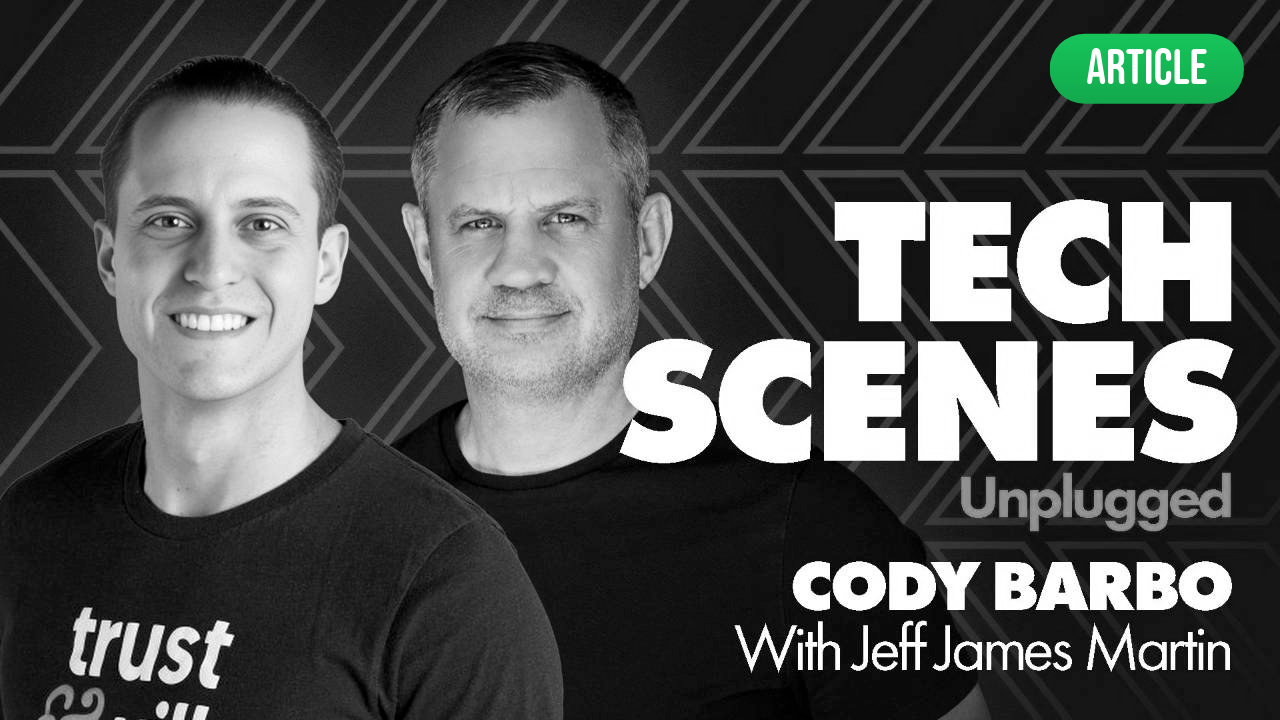
Insights from Tech Scenes Unplugged with Cody Bardo, CEO and Co-Founder of Trust & Will
One of the most dangerous moments in a company's life is often when things are working.
Revenue is growing.
Customers are happy.
The team is expanding.
Investors are supportive.
From the outside, everything appears healthy.
Yet history repeatedly shows that many successful companies fail not because they lose today, but because they stop preparing for tomorrow.
During my conversation with Cody Bardo, CEO and Co-Founder of Trust & Will, we explored what it takes to build and scale a category-defining company. While Trust & Will has become one of the leading digital estate planning platforms in America, one of the most interesting parts of the discussion had nothing to do with wills, trusts, or probate. Instead, it focused on a challenge every founder now faces: how to reinvent a successful company before disruption forces the issue.
Cody shared a perspective that should resonate with founders across every industry. Trust & Will was built on a modern technology stack and has grown rapidly, helping hundreds of thousands of families navigate estate planning. Yet despite that success, he recognized a new threat emerging from the AI revolution. His concern was not existing competitors. His concern was the possibility that an AI-native company could emerge from nowhere, backed by elite investors and purpose-built for a new era of technology.
That realization led to an important mindset shift.
The question was no longer whether AI would impact the business.
The question became whether Trust & Will would lead that transformation or be forced to react to it later.
This is a challenge facing nearly every growth company today.
For years, businesses competed on distribution, capital, talent, and execution. Those factors still matter, but AI is accelerating innovation cycles at a pace few organizations have experienced before. A startup launched tomorrow may be able to accomplish in six months what previously required several years and dozens of employees.
That reality changes how leaders must think.
The traditional approach to innovation often looked like this: build a successful business, optimize it, protect it, and gradually improve it over time.
The modern approach is different.
Build the business.
Question the business.
Reinvent the business.
Repeat.
Founders who assume today's advantages will protect them tomorrow are taking a significant risk.
The most effective leaders are now operating with a different mindset. They are constantly asking what could make their current business model obsolete and how they can build that future before someone else does.
This requires more than technology.
It requires humility.
Successful companies often struggle to change because success creates confidence. Confidence is valuable, but it can also create blind spots. When leaders believe their current approach is working, it becomes difficult to imagine a dramatically different future.
Great founders learn to challenge their own assumptions.
They ask uncomfortable questions.
What if our customers behave differently?
What if AI changes expectations?
What if our competitors move faster?
What if the next version of our industry looks nothing like the current one?
These questions are not signs of fear.
They are signs of leadership.
The best founders understand that disruption rarely announces itself in advance. By the time everyone recognizes a shift, early movers have already gained an advantage.
This is where organizational operating systems become increasingly important.
Many companies assume innovation is purely about creativity. In reality, innovation often depends on execution. Teams need mechanisms for evaluating new ideas, testing assumptions, making decisions, and implementing changes without creating chaos.
As organizations scale, innovation becomes less about individual brilliance and more about organizational adaptability.
Companies that can learn faster than competitors gain an enormous advantage.
Companies that can experiment faster gain an enormous advantage.
Companies that can align around change faster gain an enormous advantage.
These capabilities are not accidental.
They are built through systems, leadership habits, and organizational discipline.
One of the most interesting aspects of Cody's leadership philosophy is his willingness to stay curious. Throughout the conversation, he described actively exploring emerging AI technologies, studying new tools, encouraging experimentation across the company, and creating learning opportunities for employees. Rather than viewing AI as a threat, he views it as a responsibility. The organization must continuously learn, evolve, and improve.
That mindset may become one of the defining characteristics of successful companies over the next decade.
The winners will not necessarily be the largest organizations.
They will not necessarily be the oldest organizations.
They may not even be the best-funded organizations.
The winners will be the organizations willing to reinvent themselves before circumstances force them to do so.
Every founder eventually faces a choice.
Protect the current version of the company.
Or build the next version.
The leaders who consistently create long-term success choose the second path.
They understand that the future rarely belongs to those who defend the status quo.
It belongs to those willing to create what comes next.
Questions and Answers
Why is self-disruption important for founders?
Self-disruption allows organizations to adapt before external competitors force change. Companies that proactively evolve often maintain stronger competitive positions over time.
What is an AI-native company?
An AI-native company is built with artificial intelligence at the center of its products, operations, workflows, and customer experience rather than adding AI later as an enhancement.
Why do successful companies struggle to innovate?
Success can create comfort, certainty, and attachment to existing systems, making it harder to recognize and respond to emerging changes.
How does AI impact growth companies?
AI accelerates productivity, shortens innovation cycles, improves decision-making, and lowers barriers to entry, creating both opportunities and competitive threats.
What role do operating systems play during transformation?
Business operating systems help organizations manage complexity, maintain alignment, improve communication, and execute change more effectively.
How can leaders create more adaptable organizations?
Leaders can foster adaptability by encouraging experimentation, creating learning loops, improving decision-making processes, and building cultures that embrace change.
About Collective Genius
Collective Genius helps founders, CEOs, and leadership teams build scalable organizations through executive coaching, leadership development, strategic facilitation, and organizational operating systems.
https://www.collective-genius.com/
About Peak OS
Peak OS is a business operating system designed for growth companies seeking better alignment, accountability, communication, execution, and organizational clarity.
https://www.collective-genius.com/peak-os-software
About Peak Teams
Peak Teams: Mastering the Habits of Unstoppable Venture-Backed Companies explores the leadership systems, operating rhythms, and execution disciplines used by high-growth organizations.
https://www.collective-genius.com/peak-teams-book
Episode Links
Collective Genius:
https://www.collective-genius.com/blog/tech-scenes-unplugged-with-cody-bardo-ceo-and-co-founder-of-trust-will
YouTube:
https://youtu.be/QuuNc2t-BJY
Spotify:
https://open.spotify.com/episode/6QAiITmnHpoIsJjkDes858?si=moO1yTf0Qr6yd_SE8iG4Gw
Related Articles
Why AI Is Forcing Growth Companies to Rethink Their Operating Systems
https://www.collective-genius.com/blog/why-ai-is-forcing-growth-companies-to-rethink-their-operating-systems
Why AI Makes Leadership More Important
https://www.collective-genius.com/blog/Why-AI-Makes-Leadership-More-Important
Why AI Makes Organizational Alignment More Important, Not Less
https://www.collective-genius.com/blog/why-ai-makes-organizational-alignment-more-important-not-less
Why AI-Native Companies Are Rebuilding Operating Systems From Scratch
https://www.collective-genius.com/blog/why-ai-native-companies-are-rebuilding-operating-systems-from-scratch
Why The Future Belongs to Organizations That Can Adapt Faster Than Change
https://www.collective-genius.com/blog/why-the-future-belongs-to-organizations-that-can-adapt-faster-than-change
Why Growth Companies Need Faster Organizational Learning Loops
https://www.collective-genius.com/blog/why-growth-companies-need-faster-organizational-learning-loops
Why Alignment Becomes a Competitive Advantage as Companies Scale
https://www.collective-genius.com/blog/why-alignment-becomes-a-competitive-advantage-as-companies-scale
