
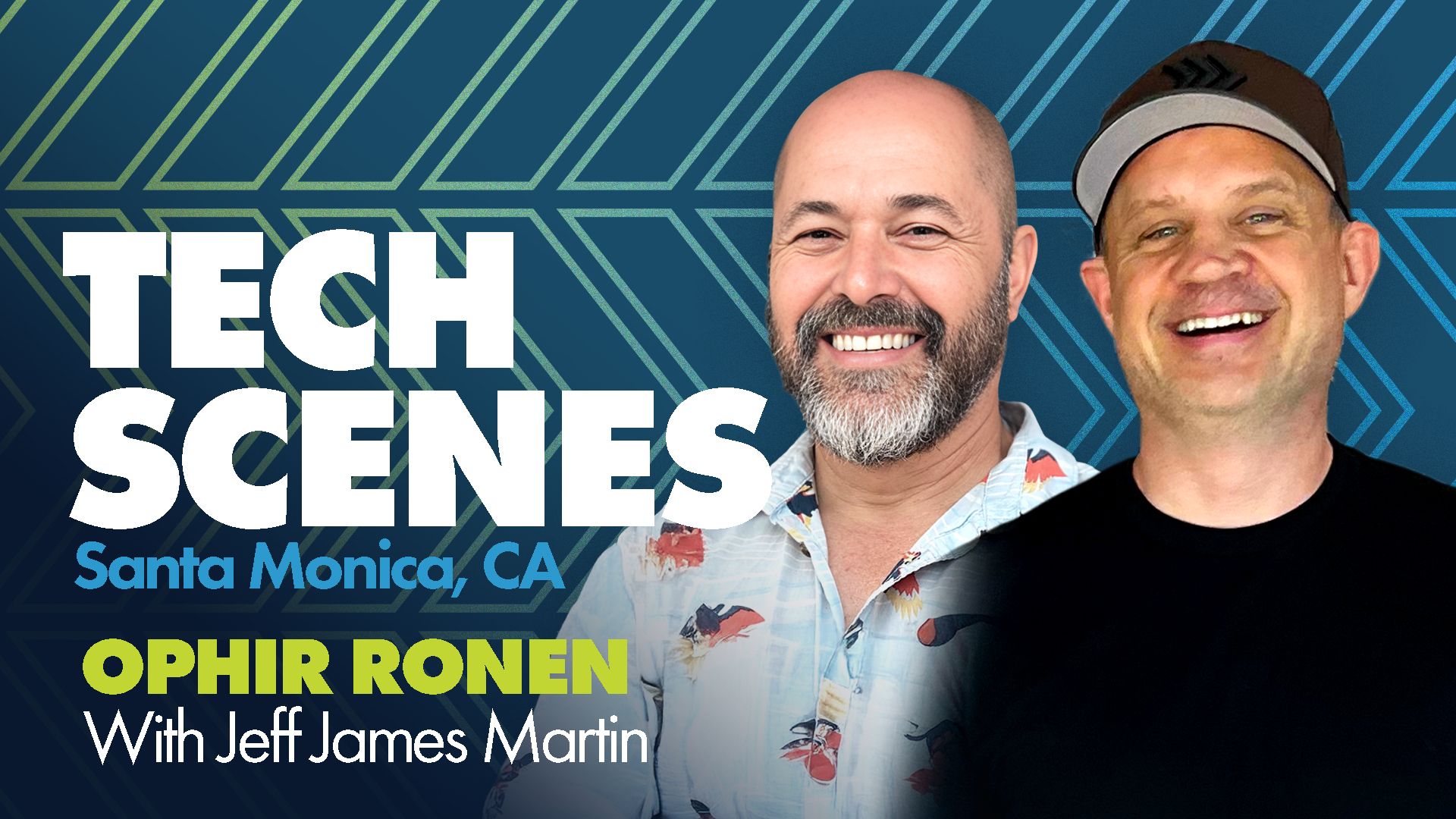
Tech Scenes Santa Monica with Ophir Ronen, CEO of CalmWave
Tech Scenes Santa Monica with Ophir Ronen, CEO of CalmWave
Why Great Organizations Learn to Separate Signals from Noise
In this episode of Tech Scenes Santa Monica, Collective Genius Founder Jeff Martin sits down with Ophir Ronen, CEO of CalmWave, to explore a challenge that exists not only in healthcare, but in nearly every modern organization:
How do you know which signals deserve attention?
For hospitals, the problem appears in the form of alarm fatigue.
For businesses, it appears as endless notifications, dashboards, meetings, metrics, alerts, and competing priorities.
In both cases, too much noise creates the same outcome:
People stop paying attention.
What begins as an information problem eventually becomes an operational problem.
And in mission-critical environments, operational problems become human problems.
The conversation with Ophir explores healthcare innovation, systems thinking, operational excellence, AI, leadership, decision-making, and the hidden costs of information overload.
Watch and Listen
Watch the Full Episode on YouTube
Listen on Spotify
https://open.spotify.com/episode/6sO7kq38dMHZyJM4FNPFss?si=wEwq7XsSRtOaYpveefaEBA
Meet CalmWave
CalmWave is an operational intelligence platform focused on solving one of healthcare's longest-running challenges:
ICU alarm fatigue.
In modern intensive care units, patients generate hundreds—and often thousands—of alarms each day.
Many of these alarms are technically correct.
Most are not actionable.
The result is a constant stream of noise that impacts nurses, physicians, patients, and family members.
CalmWave uses operational intelligence, data science, AI, and systems thinking to reduce unnecessary alarms while preserving patient safety.
The company's broader vision extends beyond healthcare.
It is about helping complex systems distinguish between meaningful signals and distracting noise.
The Hidden Cost of Alarm Fatigue
One of the most surprising insights from the conversation is how long this problem has existed.
Research discussing alarm fatigue dates back to the 1950s.
For decades, healthcare professionals have documented the consequences:
-
Excessive noise
-
Cognitive overload
-
Staff burnout
-
Reduced responsiveness
-
Increased operational risk
According to Ophir, patients can experience up to 1,600 alarms per day in some ICU environments.
Many of those alarms do not require action.
When people are exposed to constant alerts, their ability to distinguish what matters begins to deteriorate.
This is not simply a healthcare problem.
It is a human problem.
Why Every System Produces Signals
One of the central ideas discussed during the episode is that every system generates signals.
Hospitals generate signals.
Software generates signals.
Manufacturing systems generate signals.
Organizations generate signals.
Teams generate signals.
The challenge is not collecting information.
The challenge is determining which information deserves attention.
As Ophir explains, operational maturity often depends on an organization's ability to separate alarms from meaningful action.
The organizations that do this well move faster, make better decisions, and reduce unnecessary complexity.
Alerts vs. Alarms
A distinction Ophir makes throughout the conversation is the difference between alarms and alerts.
Alarms originate from systems.
Alerts are what get delivered to people.
Many organizations make the mistake of creating a one-to-one relationship between the two.
Every signal becomes an interruption.
Every interruption becomes a distraction.
Every distraction creates cognitive load.
The result is a workforce overwhelmed by information but lacking clarity.
The best organizations learn to filter, prioritize, and contextualize information before it reaches decision-makers.
What Enterprise Technology Taught Healthcare
Before founding CalmWave, Ophir spent decades building and scaling technology companies.
His experience includes helping build one of the early commercial internet backbones and later developing operational intelligence technology that became part of PagerDuty.
Throughout those experiences, he observed a recurring pattern:
Every large-scale system eventually develops signal overload.
Enterprise IT solved many of these challenges through sophisticated event management and operational intelligence platforms.
CalmWave applies similar principles to healthcare.
The result is a new approach to reducing alarm fatigue while preserving critical information.
Why Healthcare Was the Right Place to Start
Healthcare may seem like an unusual first market.
It is highly regulated.
The stakes are extraordinarily high.
The environment is incredibly complex.
Yet those challenges are precisely why CalmWave chose it.
As Ophir explains, if a solution can succeed inside an ICU, it can succeed almost anywhere.
ICUs represent some of the most mission-critical operational environments in the world.
Improving outcomes there creates opportunities for broader applications across industries.
Turning Data into Context
One of the company's biggest breakthroughs involves combining data sources that traditionally remain isolated.
Healthcare systems often separate:
-
Medical records
-
Patient vitals
-
Device alarms
-
Operational workflows
Individually, each data source provides partial visibility.
Combined, they provide context.
Context transforms information into insight.
Insight enables better decisions.
This principle applies far beyond healthcare.
Most organizations suffer from fragmented information.
The companies that learn to connect data effectively gain significant advantages.
Why Context Matters More Than Information
A recurring theme throughout the episode is that more information rarely solves a problem.
More context does.
Organizations often believe the answer to uncertainty is collecting additional data.
In reality, leaders frequently already possess enough information.
What they lack is context.
Context allows people to understand:
-
What matters
-
What is changing
-
What requires action
-
What can safely be ignored
Without context, teams drown in information.
With context, teams create alignment.
The Founder Journey
Like many successful founders, Ophir did not discover CalmWave through a traditional startup process.
The opportunity emerged through curiosity.
During a sabbatical following his time at PagerDuty, Ophir became involved with search and rescue operations.
Through conversations with healthcare professionals, he repeatedly heard stories about ICU alarm fatigue.
Rather than immediately building a product, he began researching the problem.
What he discovered was decades of academic literature describing a challenge that remained largely unsolved.
That insight became the foundation for CalmWave.
Why Great Founders Start with Questions
One of the strongest lessons from the conversation is the importance of curiosity.
Ophir did not begin with a solution.
He began with questions.
He spent time:
-
Reading research
-
Interviewing experts
-
Understanding workflows
-
Validating assumptions
Only after identifying patterns did he begin building.
Many founders make the opposite mistake.
They become attached to solutions before understanding the problem.
The most successful entrepreneurs often become obsessed with understanding reality first.
Vision, Execution, and Operational Discipline
The discussion eventually shifts toward leadership and organizational execution.
As CalmWave has grown, maintaining focus has become increasingly important.
Ophir highlights three foundational values that guide the organization:
-
Integrity
-
Open and direct communication
-
Bias toward action
These principles influence how decisions are made, how teams collaborate, and how the company scales.
The goal is not simply to build software.
The goal is to build an organization capable of executing consistently over time.
Why Decision-Making Matters
One of the most practical insights from the conversation centers on decision-making.
Many organizations become trapped by uncertainty.
Teams delay decisions while waiting for perfect information.
Leaders postpone action while seeking complete certainty.
The result is stagnation.
Ophir argues that making thoughtful decisions—even imperfect ones—is often better than remaining stuck.
Organizations learn by moving.
Progress creates information.
Information creates clarity.
Clarity enables better decisions.
The learning cycle depends on action.
The Importance of Communication Loops
As organizations grow, communication becomes increasingly important.
Vision alone is not enough.
Leaders must continuously reinforce:
-
Direction
-
Priorities
-
Expectations
-
Progress
-
Learning
The companies that scale successfully create communication loops that keep everyone aligned.
Without communication, alignment fades.
Without alignment, execution slows.
Without execution, growth becomes difficult.
Why Burnout Is an Operational Problem
Another important topic discussed is burnout.
Many organizations attempt to operate in a constant state of urgency.
The result is predictable:
Exhaustion.
Burnout.
Turnover.
Declining performance.
Ophir emphasizes that sustainable execution requires balance.
Organizations need moments of intensity.
But they also need recovery.
High performance is not about operating at maximum speed all the time.
It is about knowing when to accelerate and when to recover.
What CalmWave Reveals About Modern Leadership
At its core, CalmWave's mission is not simply about reducing alarms.
It is about improving decision-making inside complex systems.
That same challenge exists in every organization.
Leaders today face:
-
More information
-
More complexity
-
More technology
-
More distractions
The organizations that thrive will not necessarily have more data.
They will have better filters.
They will understand which signals deserve attention.
And they will build systems that help people focus on what matters most.
Key Quotes from the Episode
"Every system generates signals."
"Alerts are what you send to people. Alarms are what systems generate."
"If you're expecting an alarm and don't hear it, that's worse than hearing too many."
"Any domain with sensors eventually develops alarm fatigue."
"Integrity, communication, and bias for action."
"Make a decision."
"The goal is not more information. The goal is better context."
"If you want to go faster, sometimes you need to slow down."
Key Takeaways
-
Every organization produces more signals than people can process.
-
Operational maturity depends on filtering noise.
-
Context matters more than raw information.
-
Decision-making creates learning.
-
Communication loops drive alignment.
-
Burnout often results from poor operational design.
-
Great founders start with curiosity.
-
Mission-critical environments reveal important truths about systems.
-
Sustainable execution requires recovery cycles.
-
Organizations scale faster when they focus on the signals that matter.
Frequently Asked Questions
What is alarm fatigue?
Alarm fatigue occurs when individuals are exposed to so many alarms that their responsiveness and attention begin to decline.
What does CalmWave do?
CalmWave helps healthcare organizations reduce non-actionable alarms and improve operational efficiency using AI, data science, and operational intelligence.
Why is alarm fatigue dangerous?
Excessive alarms can create cognitive overload, increase burnout, reduce responsiveness, and negatively impact patient care.
What is operational intelligence?
Operational intelligence involves analyzing system data in real time to improve decision-making, performance, and outcomes.
How does this apply outside healthcare?
Every industry that generates large volumes of signals, alerts, or data faces similar challenges with prioritization, attention, and operational effectiveness.
Why is context important?
Context helps people understand what deserves attention, what requires action, and what can safely be ignored.
Related Insights
What Is Organizational Execution?
What Is Organizational Intelligence?
What Is a Business Operating System?
About the author
Jeff James MartinCEO and Founder, Collective Genius
Jeff James Martin is the Founder and CEO of Collective Genius, creator of Peak OS, and author of Peak Teams. He works with growth and mission-critical organizations to improve alignment, accountability, execution, and team performance. Over the past two decades, Jeff has helped hundreds of founders, executives, and leadership teams build stronger operating rhythms and scale through increasing complexity. He is also the host of Tech Scenes, where he interviews founders, investors, and operators on leadership, innovation, and organizational performance.
About Peak OS
Peak OS is the operating system for organizational execution. Designed for growth-stage and mission-critical organizations, Peak OS helps leadership teams align priorities, establish operating rhythm, improve accountability, and maintain visibility as organizational complexity increases. By creating a consistent framework for communication, planning, and execution, Peak OS helps teams reduce execution drift and turn strategy into measurable outcomes. Learn more: Collective Genius
About Collective Genius
Collective Genius helps founders, executive teams, and growing organizations improve organizational execution through leadership coaching, operating systems, strategic facilitation, and Team-of-Teams alignment. Our work focuses on helping organizations scale without losing clarity, accountability, communication, or momentum. Learn more: Collective Genius
About Peak Teams
Peak Teams: Mastering the Habits of Unstoppable Venture-Backed Companies explores the leadership habits, operating rhythms, accountability systems, and execution principles used by high-performing organizations. The book provides practical frameworks for leaders seeking to build aligned teams and execute consistently as complexity grows. Learn more: Peak Teams book
Learn More
Explore additional insights on organizational execution, operating rhythm, leadership, team alignment, business operating systems, artificial intelligence, and the future of work through the Collective Genius Insights platform. Visit: Collective Genius Insights
Music by Andrew Applepie - https://soundcloud.com/andrewapplepie
